
Searched on Google often. Worth answering once, properly.
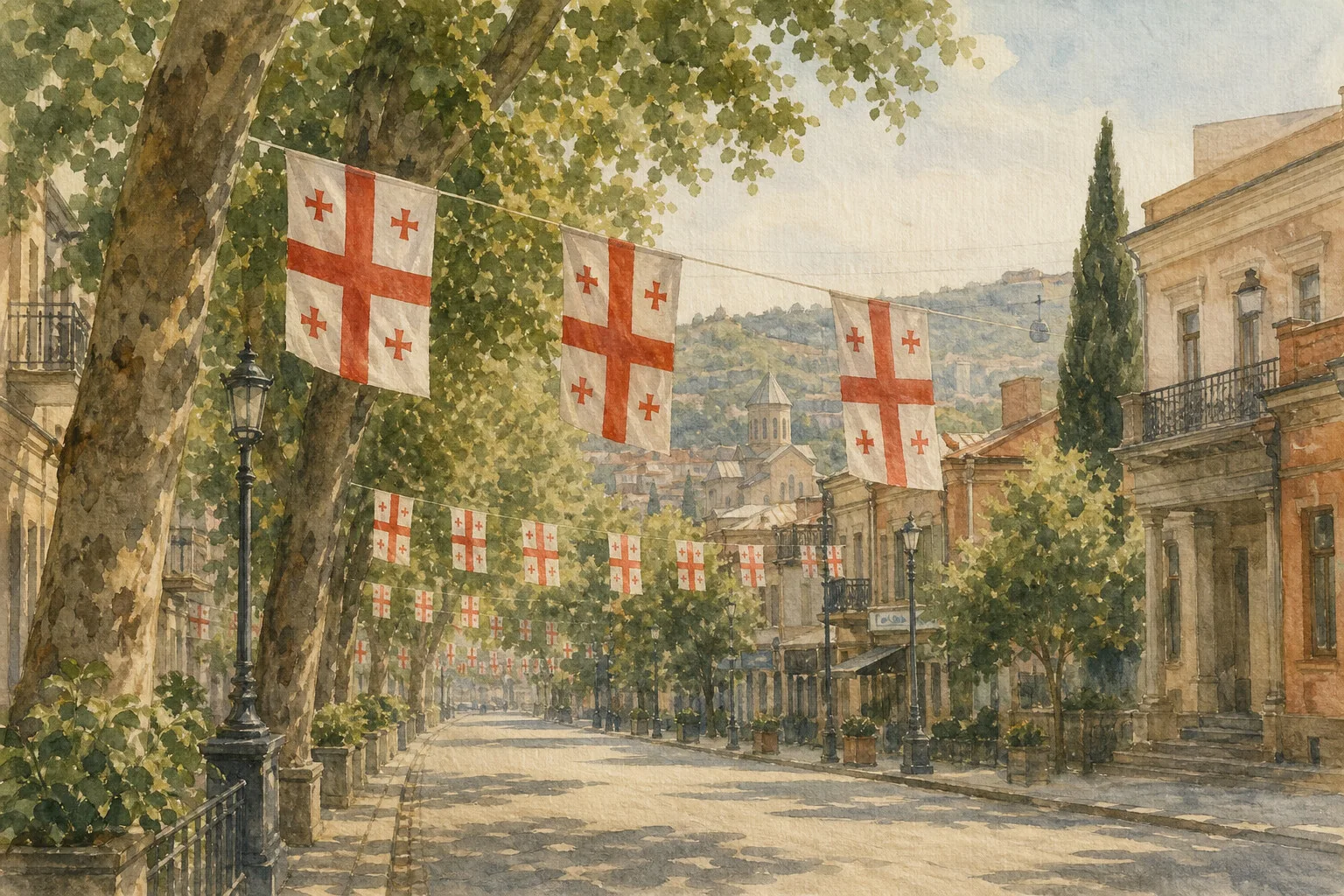
The country of Georgia (population ~3.7 million, capital Tbilisi, not to be confused with the U.S. state) has one official language: Georgian. Roughly 86 percent of the population speaks it as their first language. Outside that, the picture is more interesting.
Georgian
Georgian is the only language in the world that uses the Georgian alphabet. It is part of a language family called Kartvelian, which has only four members and exists almost entirely inside Georgia’s borders. Georgian is unrelated to Russian, unrelated to Turkish, unrelated to most of the languages spoken near it. Linguistically, it is on its own island.
Georgian is what you hear in cafes, on TV, on signs, in schools, in churches, and in any conversation between two locals. If you intend to live in Georgia for any length of time, this is the language to learn.
Russian
A meaningful share of Georgians speak Russian fluently as a second language, mostly people over 35 who grew up in the Soviet Union. In Tbilisi, Russian is also the default lingua franca with the wave of Russian, Belarusian, and Ukrainian arrivals after 2022. You will hear it in service jobs, taxis, and certain neighbourhoods more than others.
Russian is not an official language of Georgia and is politically a sensitive subject. Many younger Georgians actively prefer to use English with foreigners rather than Russian. Speaking Russian as a foreigner is useful in some situations and unwelcome in others. Pay attention to the context.
Other languages spoken in Georgia
A few smaller languages appear in specific regions:
Mingrelian (Megrelian), spoken by several hundred thousand people in western Georgia (the Samegrelo region). Related to Georgian, but not mutually intelligible. Mingrelian speakers are also fluent in Georgian.
Svan, spoken by roughly 30,000 people in the Svaneti region, in the high Caucasus. Also Kartvelian. Also unintelligible to a Georgian speaker without exposure. Svan has no standard written form.
Laz, spoken by a small community along the Black Sea coast, and by a much larger community across the border in Turkey.
Azerbaijani, first language of the Azerbaijani community in Kvemo Kartli, a region south of Tbilisi.
Armenian, first language in Samtskhe-Javakheti, a region near the Armenian border.
These minority languages don’t appear on Georgia’s national TV, road signs, or government forms. People who speak them speak Georgian as well.
English
In Tbilisi specifically, English is widely spoken by people under 35, especially in service roles. You can survive most tourist-facing interactions in English. In supermarkets, hospitals, banks, and government offices, you can’t. Outside Tbilisi, English fluency drops off fast.
If you only intend to visit Georgia for a week, English is enough. If you intend to live here, it isn’t.
What to learn
If you are going to live in Georgia and speak with locals, learn Georgian. Russian is a second-best fallback that opens fewer doors than it used to. English-only works only for tourists.
The Georgian alphabet looks intimidating but isn’t. The grammar has cases and screeves but isn’t unfair. Most of what makes Georgian feel hard is that the language industry has skipped it for so long that the resources have been bad. That part is changing. Audio courses, structured podcast input, modern flashcards. There is finally a way in.
So: Georgian is the language of Georgia. Russian is the second one a lot of people end up using. English buys you a Tbilisi cafe. The honest path for anyone planning to stay is to start on Georgian early, even badly.