
Georgian Independence Day is May 26. If you have spent any time in Tbilisi in late May, you have seen it coming: flags going up along the avenues, posters, the city tightening for a parade. I have been here for every May 26 since 2021, and it took me a couple of years to understand what the date actually marks. It is not the day Georgia left the Soviet Union. It is older than that, and the story is worth knowing if you are learning the language or building a life here.
What Georgian Independence Day is
May 26 marks the founding of the Democratic Republic of Georgia in 1918. On that day the National Council of Georgia adopted the Act of Independence, and Georgia became an independent state for the first time in the modern era.
The timing was the chaos after the Russian Revolution. Georgia had been part of the Russian Empire since the early 19th century. When the empire collapsed, the South Caucasus briefly held together as one federation with Armenia and Azerbaijan, then split. On May 26, 1918, Georgia declared its own republic.
The Democratic Republic of Georgia did not last long. Soviet Russia occupied it in February 1921, less than three years after it was declared. But those three years were real. The republic had a constitution, multi-party elections, a parliament, and recognition from European governments. That is the thing May 26 honors.
Why May 26, and not 1991
Here is the part that surprises people. Georgia restored its independence in April 1991, months before the Soviet Union officially dissolved. That restoration has its own day in the calendar, April 9. But the country’s Independence Day stayed on May 26.
Georgia kept the 1918 date. The modern country treats the 1991 restoration as exactly that, a restoration, the recovery of something that already existed. The independent state was founded in 1918. 1991 gave it back.
It is a small decision with a lot inside it. A country that dates its independence to 1918 is saying the Soviet period was an occupation, not an origin. For anyone learning about Georgia, that framing explains a lot about how Georgians talk about their own history.
How Tbilisi marks the day
May 26 is a public holiday. Government offices, banks, and many businesses close.
The center of it is Rustaveli Avenue, the main avenue in Tbilisi. The day usually opens with formal speeches and a military parade, and new recruits to the Georgian armed forces take their oath. Through the afternoon Rustaveli turns into something closer to a street festival: concerts, stalls, performances, the avenue closed to traffic and full of people. After dark there are fireworks over the city.
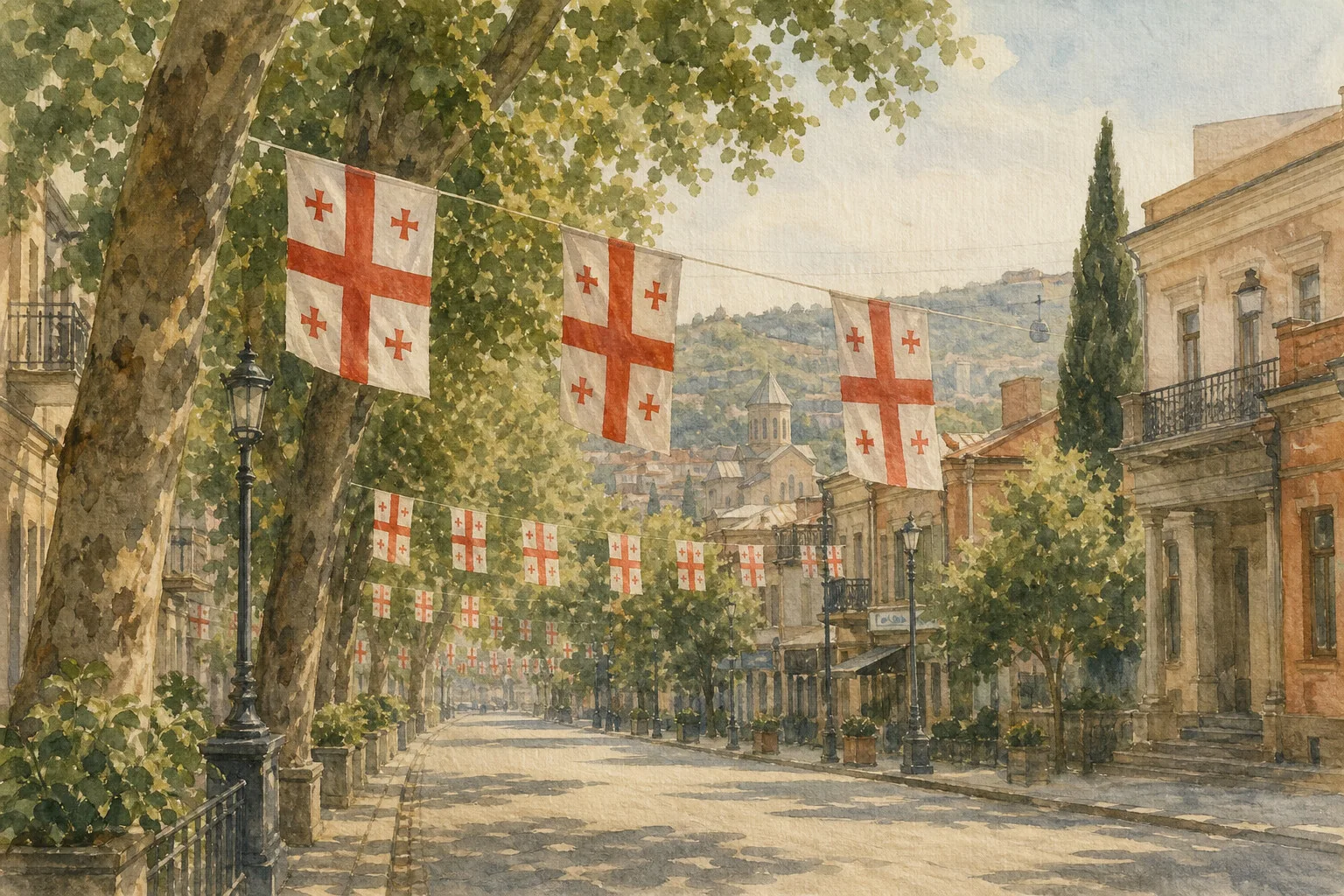
Flags go up everywhere in the days before. The white-and-red Georgian flag, with its five crosses, ends up on balconies, lampposts, and shopfronts across the city. If you are in Tbilisi in the last week of May, you do not have to look for the holiday. It finds you.
What it looks like as a foreigner here
My first year, May 26 was just a day off. I did not know what it was for. I suspect that is true for a lot of new arrivals: you register that the city is busy and the shops are shut, and you leave it there.
It lands differently once you know the story and once you have started learning the language. A national day is one of those things that stays opaque until you can read a poster, catch a phrase, follow a sentence of a speech. Learning Georgian is partly about exactly this, the difference between watching a country’s holiday from outside and being a small part of it.
You do not need much. Knowing what 1918 means, being able to say hello in Georgian and wish someone a good holiday, raising a glass to Georgia at a table on the 26th. Georgians notice the effort, and on Independence Day of all days, they notice it warmly.
If May 26 has you thinking it is finally time to start, that works out well. To mark the holiday, every EasyGeorgian course is 15% off on Independence Day itself.
A few Georgian words for the day
If you want to mark May 26 in Georgian, here are the words that carry the day.
The country’s own name for itself is Sakartvelo (საქართველო). Not “Georgia”, which is the name most of the world uses from outside. Georgians call their country Sakartvelo and their language kartuli.
Independence is damouk’idebloba (დამოუკიდებლობა). It is a long word, and worth slowing down on. Independence Day itself is damouk’ideblobis dghe (დამოუკიდებლობის დღე).
To wish someone a happy Independence Day, the phrase is gilotsavt damouk’ideblobis dghes (გილოცავთ დამოუკიდებლობის დღეს), roughly “I congratulate you on Independence Day”. Gilotsavt is the all-purpose congratulations verb, the one Georgians use for birthdays, holidays, and good news of any kind.
And if you find yourself at a supra on the 26th, the toast is sakartvelos gaumarjos (საქართველოს გაუმარჯოს), “to Georgia”. It is one of the Georgian toasts you will hear most, holiday or not, and May 26 is the day it means the most.