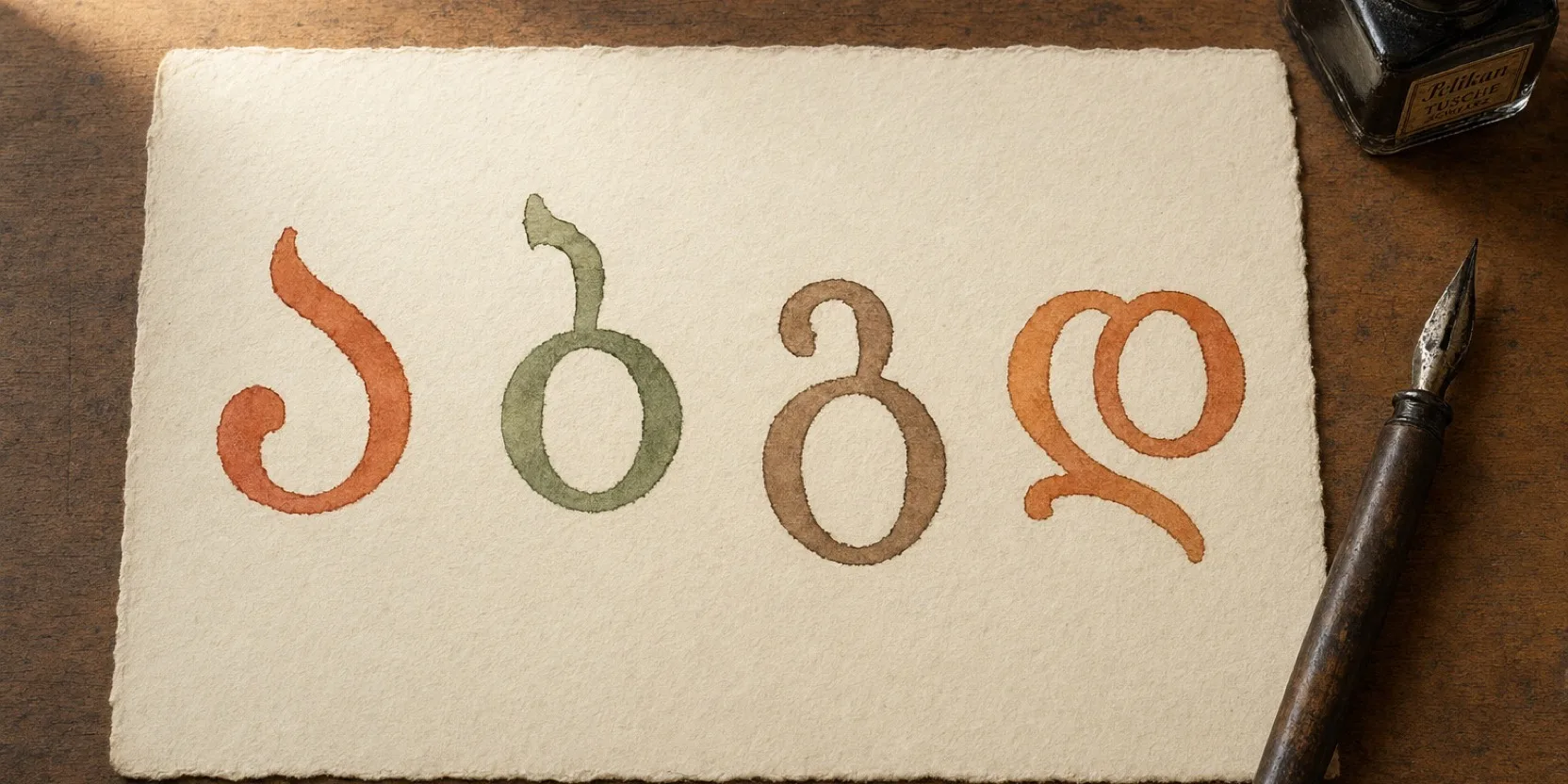

The Georgian alphabet is one of fourteen scripts in active use anywhere in the world. Almost every other language on the planet has long since adopted Latin, Cyrillic, Arabic, or one of the East Asian scripts. Georgia kept its own. And the script you’ll see on every shop sign, menu, and street name in Tbilisi has been doing its job, in some form, for around 1,500 years.
If you’re learning Georgian, you’ll meet this alphabet in week one. This post is mostly about what it is and how to learn it without making the typical mistake. (We made a free video that handles the actual teaching. More on that further down.)
What you’ll actually use: Mkhedruli
The script you read on a coffee menu is called Mkhedruli. The name comes from a word meaning “of the warriors,” which sounds dramatic but historically just meant “secular” or “everyday,” as opposed to ecclesiastical scripts used by the church.
Mkhedruli has 33 letters. No capital letters. (There’s a rare uppercase form called Mtavruli used on signs and headlines, but it’s not a true case system the way English has.) The script is fully phonetic: one letter, one sound, almost always. You don’t have to wonder how a word is pronounced once you can read it. Compare to English, where though, through, thought, tough share four pronunciations of the same letters and nobody can defend it.
A short history (the part most people skip)
Georgia has had three writing systems over the centuries.
Asomtavruli is the oldest, dating to about the 5th century. Round, ceremonial, monumental. You see it on inscriptions inside old Georgian churches. Each letter looks like something carved into stone, because most surviving examples are. If you visit Mtskheta or Sighnaghi or any old monastery, the script you see chiseled into the walls is Asomtavruli.
Nuskhuri came later, around the 9th century. More angular, more compact, used in old manuscripts and religious texts. Together with Asomtavruli, it forms what’s called Khutsuri, the “ecclesiastical script.” You’ll see Nuskhuri in old Bibles and saints’ lives, almost never on the street.
Mkhedruli (the one you’ll use) emerged around the 11th century and gradually became the script of secular life. Books, contracts, poems, eventually newspapers. By the 19th century it had pushed the older two scripts entirely into religious use. Today it does almost all the work.
In 2016, UNESCO listed all three Georgian scripts as Intangible Cultural Heritage. Georgians are rightly proud of this. It’s the kind of thing that comes up at supras after the fourth toast.
What makes the Georgian alphabet easier than it looks
The alphabet is the part of Georgian that scares people most before they start, and the easiest part once they begin. A few specific reasons:
- One letter, one sound. Outside of the ejective/aspirated distinction (which is a pronunciation thing, not a spelling thing), the script reads exactly as written. No silent letters. No vowel changes. No “i before e” rules.
- No capitals. There’s no upper/lower case to learn twice.
- No special letter forms. Letters don’t connect or change shape based on position the way Arabic letters do.
- Just five vowels. And five vowel letters, in a clean one-to-one mapping. Compare to English’s twelve to twenty vowel sounds spelled with five letters in dozens of combinations.
- No diacritics or accents. What you see is what you get.
Most of the difficulty people experience comes from unfamiliarity with the shapes, not from any underlying complexity in the system.
The 33 letters, with sound
Tap any letter to hear it. This is the working set: 33 letters, no capitals, fully phonetic. Use this as a reference to play with the sounds, not as a chart to drill in order.
Tap any letter to hear it.
The vowels (a, e, i, o, u) and most consonants will sound roughly familiar to English speakers. The ones people fixate on before starting are a small set:
- The kh (ხ) and gh (ღ) are made at the back of the throat. Kh is the Scottish ch in loch, or the German Bach. Gh is the same place, voiced. You’ll meet kh on day one in khachapuri and khinkali.
- The q’ (ყ) is the single letter with no real counterpart in any major European language. It’s made even further back than kh, with a small click in the throat. You’ll get it eventually. Don’t fight it on day one.
- The ejectives (the apostrophed letters: k’, p’, t’, ts’, ch’) are pronounced at the same mouth position as their non-ejective counterparts (k, p, t, ts, ch) but with the throat closed off so no air escapes. The result is a sharper, drier, popped version of the same sound. Tap ქ (k) and კ (k’) back to back to hear the difference.
The ejectives are the part of Georgian pronunciation that takes time. They lock in over the audio course, not over an afternoon with a chart. Recognise the letters, know which ones are the dry-popped versions, move on.
How not to learn the alphabet
The classic mistake, and one we’ve seen variations of in every Georgian textbook ever produced, is to print out a chart of all 33 letters in alphabetical order and try to memorise them as a list. Letter, name, sound, repeat 33 times.
This is slow, demotivating, and doesn’t stick. The brain is bad at learning a long sequence of unfamiliar shapes that have no meaning attached to them. Most learners get a third of the way through the chart, get tired, and put it away. Two weeks later they remember about six letters.
How to actually learn it
The way the brain actually learns an alphabet is by seeing letters in context. Words you can guess. Signs you can decode. Names you already know written in a new shape. The shapes lock in when they’re attached to meaning.
This is what our free 56-minute alphabet video does. It introduces the Georgian letters by first hiding them inside English sentences, where you can guess each new letter’s sound from the surrounding context. By the back half of the video, you’re decoding real Georgian street signs. By the end, you can read.
It’s free in the EasyGeorgian app for anyone who signs up. Fifty-six minutes. We deliberately built it as an evening’s-worth-of-attention thing rather than a multi-week course, because that’s how long it should actually take. The alphabet is not the hard part of Georgian. It’s the doormat at the entrance.
After the alphabet
Once you can read the script (which you can do by tonight, honestly, if you start the video after dinner), the actual work of learning Georgian begins: vocabulary, listening, speaking, and eventually grammar. The alphabet is only useful once you have words to put on top of it.
Start the video. Then start the first lesson of the audio course the same evening. By the end of next week, you’ll be able to read shop signs, recognise your own name in Mkhedruli, and order coffee at the bakery without thinking about it.
That’s how the alphabet earns its place: as a small same-day investment that unlocks every Georgian word you’ll ever read.