

If you have decided to learn Georgian, you have decided to learn a language that the modern language industry has mostly skipped. Duolingo doesn’t support it. Memrise doesn’t support it. Babbel doesn’t support it. Rosetta Stone doesn’t support it. Until very recently, your options were dusty textbooks, private teachers, and a handful of apps that were really just word-and-translation lists.
That has started to change. There is now a stack of modern tools for Georgian, but knowing how to put them together is non-obvious. So this is the version I wish I had when I arrived in Tbilisi five years ago.
I’ll go through it in the order I think it should be done. The whole thing, start to conversational, is about three to six months of honest effort.
Step 1: Learn the alphabet (one afternoon)
The Georgian alphabet (Mkhedruli, the script you actually use) is 33 letters, fully phonetic, no capitals. It looks intimidating because it is unfamiliar, not because it is complicated. One letter, one sound, almost always.
The mistake most people make is treating the alphabet like a memorisation chart. They print it, they stare at it, they try to drill the letters in alphabetical order. This is slow and demotivating.
The faster way is contextual. Learn the letters by reading words that already mean something to you. The English version of taxi in Georgian script. The English version of coffee. Your name. The names of streets near where you live. Letter shapes start to lock in within an hour or two of reading.
We made a free 56-minute alphabet video that does exactly this: introduces letters inside English sentences first, then progresses to real Georgian street signs by the end. Free in the EasyGeorgian app for anyone who signs up. There is no good reason to spend longer than an afternoon on the alphabet.
You don’t need perfect pronunciation at this stage either. The ejective consonants (the p, t, k, ts, ch with a closed glottis) take time to lock in, and the audio course will continue to refine them over the following weeks. For now, get familiar with the sounds, learn to roughly tell which is which, and move on. Don’t let pronunciation perfectionism keep you on the alphabet for two weeks.
Step 2: Acquire, don’t study (the first month)
Once you can read, the next thing your brain needs is volume of Georgian audio at real speed. Not slowed-down textbook audio. Real spoken Georgian, repeated.
This is also the moment to internalise something most adult learners forget: you don’t have to study a language to learn it. You can acquire it the way children do, by absorbing comprehensible input. Adults can do this too. It’s slower than for kids and a bit noisier, but it works, and it works far better than memorising rules from a chart.
Practically, this is the step almost every learner skips, because it doesn’t feel like studying. You’re not “doing” anything. You’re putting Georgian in your ears while you walk to the bakery, while you cook, while you fall asleep. The first ten hours feel useless. By hour twenty or thirty, the rhythm of the language starts emerging. Your brain notices where the words end. By hour fifty, you start to catch meaning in the gaps.
Do not skip this. The people who skip the input phase end up with grammar in their head and no ear, and they freeze the first time someone speaks to them at normal speed.
The audio sources I would actually use:
- A structured audio course, where the listening is paired with prompted speech.
- A comprehensible-input podcast, slow and ultra-clear, paced for a learner who is already past the absolute-beginner stage. (More on the timing below.)
- Background listening to Georgian YouTube, music, films. Less efficient per hour, but useful for volume.
Our audio course (Speak Georgian in 50 Days) and our podcast course (Advance to Georgian Mastery) cover the structured side of this. They lock together by design: the audio course teaches the vocabulary, the podcast lets you hear that vocabulary used in the wild.
Step 3: Speak before you’re ready (also the first month)
Most adult learners try to study Georgian inwardly. They read, they conjugate, they make Anki cards. They never open their mouth. The result is six months of “study” and zero conversation.
The shortcut is the opposite. Speak from week one, badly, with the wrong cases and the wrong verb forms.
The bakery counter is your friend. Erti puri, tu sheidzleba, “one bread, please”. The taxi driver is your friend. Marjvniv, “right”. Martskhniv, “left”. Aq gavcherdet, “let’s stop here”. You will be wrong every time at first. That is the price of admission. Your mouth and your retrieval system can only learn through use, and they will not learn silently.
Audio courses work specifically because they make you speak out loud during the lesson, with prompts. Use that. Repeat after the speaker. Read sentences aloud. Talk to your partner in broken Georgian even when they answer in English.
Step 4: Add structure (months 2–3)
Around month two, after a few weeks of audio and bad speaking, the lesson set you have been doing starts to feel familiar. This is when grammar stops being intimidating and starts being useful.
This is when you can add:
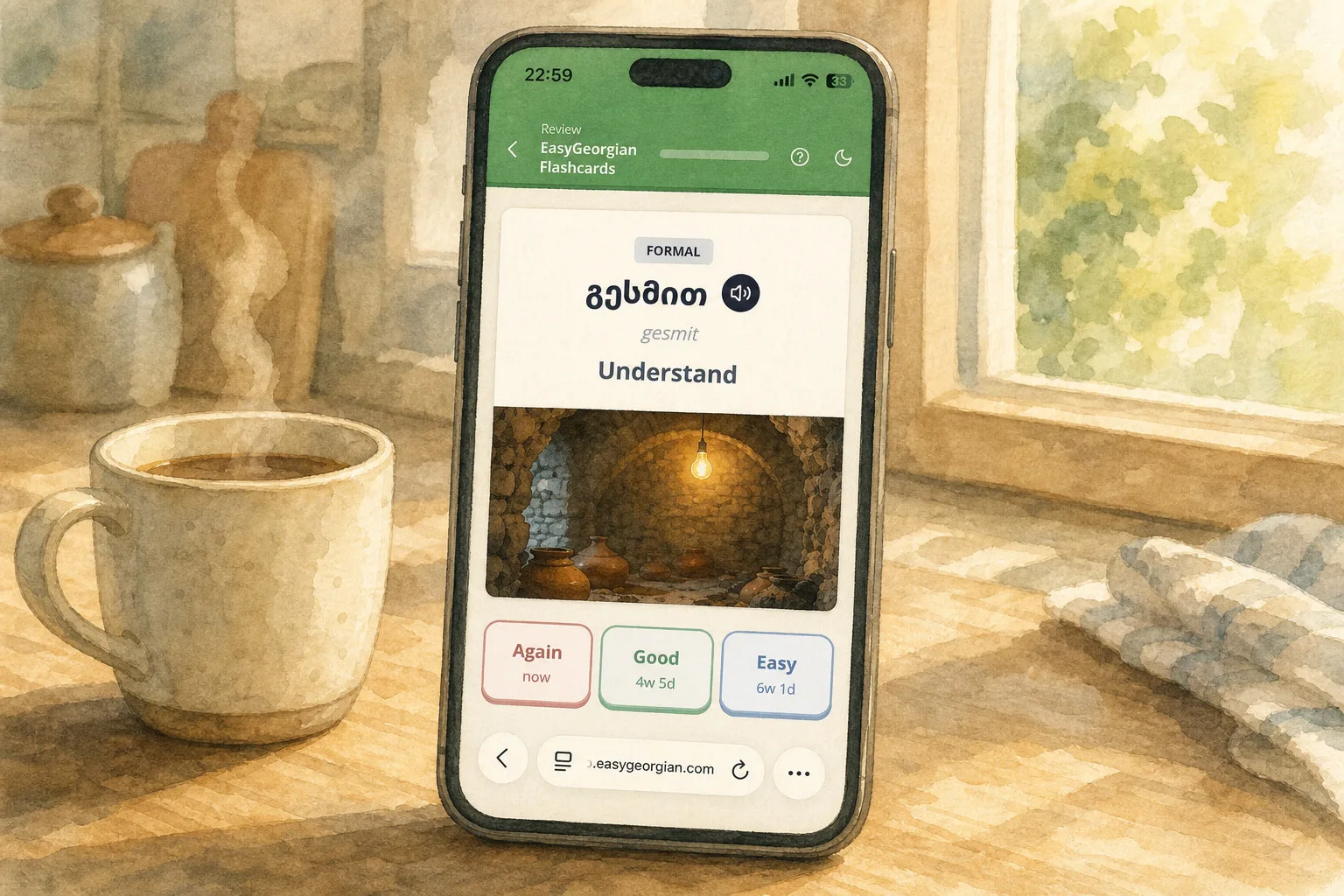
- Flashcards. Spaced repetition for the vocabulary you are already hearing in lessons. Our in-app flashcards are built for this: audio and an image on every card, drawn directly from the course vocabulary, multiple review modes (multiple choice, self-rated, written input). Memrise doesn’t support Georgian. The Anki decks people have built for Georgian are mostly bare text cards without audio or images, which is the version that makes most learners quit. Use the in-app flashcards instead.
- Light grammar reference. Not a textbook, just a quick lookup when something specific bothers you. Why does this verb end this way. Why is this word in this case. This is the “aaah, that’s why” moment that acquisition-first learners get to have. The rule slots in over an example you’ve already heard a hundred times, and the chart that would have terrified you on day one reads like an organised list of things you already know.
- Short reading. Children’s books in Georgian. Subtitles on Georgian YouTube. Anything that gives you printed sentences to decode.
You do not need to “do grammar” before this point. You really don’t. Grammar is a refinement on top of input, not a replacement for it.
Step 5: Add a teacher (only after month 3, optional)
Most expats do this in the wrong order. They book a teacher in week one. The lessons are mostly in English. Half the hour is the teacher explaining grammar. You barely speak any Georgian. You pay $20–35 an hour for the privilege.
After three months of audio + speaking + flashcards, a teacher is genuinely useful. You can keep most of the lesson in Georgian. The teacher can correct nuanced things your ear has started to detect but your mouth keeps getting wrong. Advanced grammar (cases pairing with verbs, screeve choice) becomes a productive conversation, not a chart you don’t know enough to read.
Find a teacher who will speak Georgian with you, not at you. Many are excellent. Some are still stuck in handwriting-letters-in-a-notebook mode. Try a few.
What to actually use, week by week
Compressed plan, for someone starting from zero:
- Day 1: 56-minute alphabet video, then start lesson 1 of the audio course the same day. Walk into one bakery and try a sentence.
- Weeks 1–4: Audio-course lessons 1–25, one a day. Each lesson is around half an hour and requires your full attention. People often finish one tired. Best in a quiet room or with headphones somewhere focused. Try Georgian on at least one human a day.
- Weeks 5–7: Lessons 26–50. The flashcard deck unlocks alongside the lessons. It joins the daily routine. Speaking grows.
- Months 2 onward: Audio course done. Now the priority is input volume + vocabulary. The comprehensible-input podcast course takes over as your main study material. Flashcards stay daily. Read what Georgian you can find. Add a teacher if you want, but consider holding off on explicit verb-rule lessons until after the podcast course is done. The podcast covers a lot of natural easy-tense usage that makes the explicit rules click much faster afterwards.
- Months 4–6: You are conversational. People will tell you your Georgian is excellent and they will be slightly correct. Keep going.
That’s the whole guide. It’s not magic. It works because it does the thing the language industry has been refusing to do for Georgian, which is take the modern method seriously and apply it to this specific language.
If you want the audio course and the podcast course set up so they lock together exactly as described, that’s what EasyGeorgian is. The first audio lesson is free.