

You looked for Georgian on Duolingo and didn’t find it. Same on Babbel, same on Rosetta Stone, same on most of the apps your friends have used to pick up Spanish or Italian. The biggest names in language-learning skipped Georgian, and a lot of expats moving to Georgia eventually figure that out the hard way. The good news is the landscape that actually exists for Georgian in 2026 is small and increasingly good. There are maybe five apps worth looking at, one or two worth starting with, and a sharper way to choose between them than star ratings.
A note up front: I’m the founder of EasyGeorgian, so I’m obviously biased. I’ve tried to write this honestly, name what each tool does well, and be clear about the trade-offs. Several of these apps are genuinely useful in their lane, and the people behind them are doing real work for a language the major industry skipped. Trust the framing accordingly, and check the tools yourself if you’re on the fence.
The 2026 landscape in three tiers
| Tier | What it does | Apps |
|---|---|---|
| Foundation | Builds the real conversational core. Audio-first, structured progression, depth | EasyGeorgian |
| Gamified supplement | Multiple-choice and streak-style drills. Useful in small doses, shallow on its own | Lingwing, Ling |
| Specialty supplement | Narrow tool for one thing. Sentence patterns, AI conversation, content immersion, raw flashcards | Glossika, TalkPal, LingQ, Anki |
Plus a phrasebook tier (50 Languages, uTalk, LinGo Play, and a handful of similar apps), a separate category of language-exchange apps (HelloTalk, Tandem), and the major-platform absence (Duolingo, Babbel, Rosetta Stone).
If you are starting from zero, the only Tier 1 option is EasyGeorgian, and I say that with the caveat that I built it. We built it because nothing else in Tier 1 existed for Georgian when I went looking myself. The rest of this post explains what each app actually does and where it fits.
How to evaluate a Georgian-learning app
Two questions are worth asking of any tool you’re considering:
- Does the format build the speaking reflex, or does it mostly deliver content for clicking through? Multiple-choice questions train recognition. Audio-first courses with prompted retrieval train production. Both have a place. The question is which one you need at your stage.
- Was the app built with Georgian as a primary focus, or as one course among many? Tools maintaining 60+ language courses tend to go wider and shallower on each. Tools focused on Georgian, or built by Georgian teams, tend to have more depth and more accurate audio.
Neither question gives a single right answer for everyone. They sort the field quickly though, and once you know which kind of tool you’re looking for, the choice gets simpler.
EasyGeorgian
The category we exist in is “audio-first structured course built only for Georgian, with the comprehensible-input layer that follows.” There aren’t other apps in that category for Georgian, which is the entire reason we built it. I learned Russian and Spanish through modern audio courses for those languages, then went looking for the same shape of tool for Georgian and could not find it.
What’s in the app:
- Speak Georgian in 50 Days (audio course, $79.95). 50 lessons, one per day, roughly 30 minutes each. Prompted-speech retrieval pattern, native male and female voice, structured progression that builds the conversational core in eight weeks. The reasoning behind the audio-first format is the audio course’s whole bet.
- Advance to Georgian Mastery (podcast course, $79.95). 100 episodes of slow, ultra-clear comprehensible-input Georgian, paced for an A1-A2 learner who has finished the audio course. Karaoke-style transcript, multiple translation modes.
- The bundle: $139.95 for both courses.
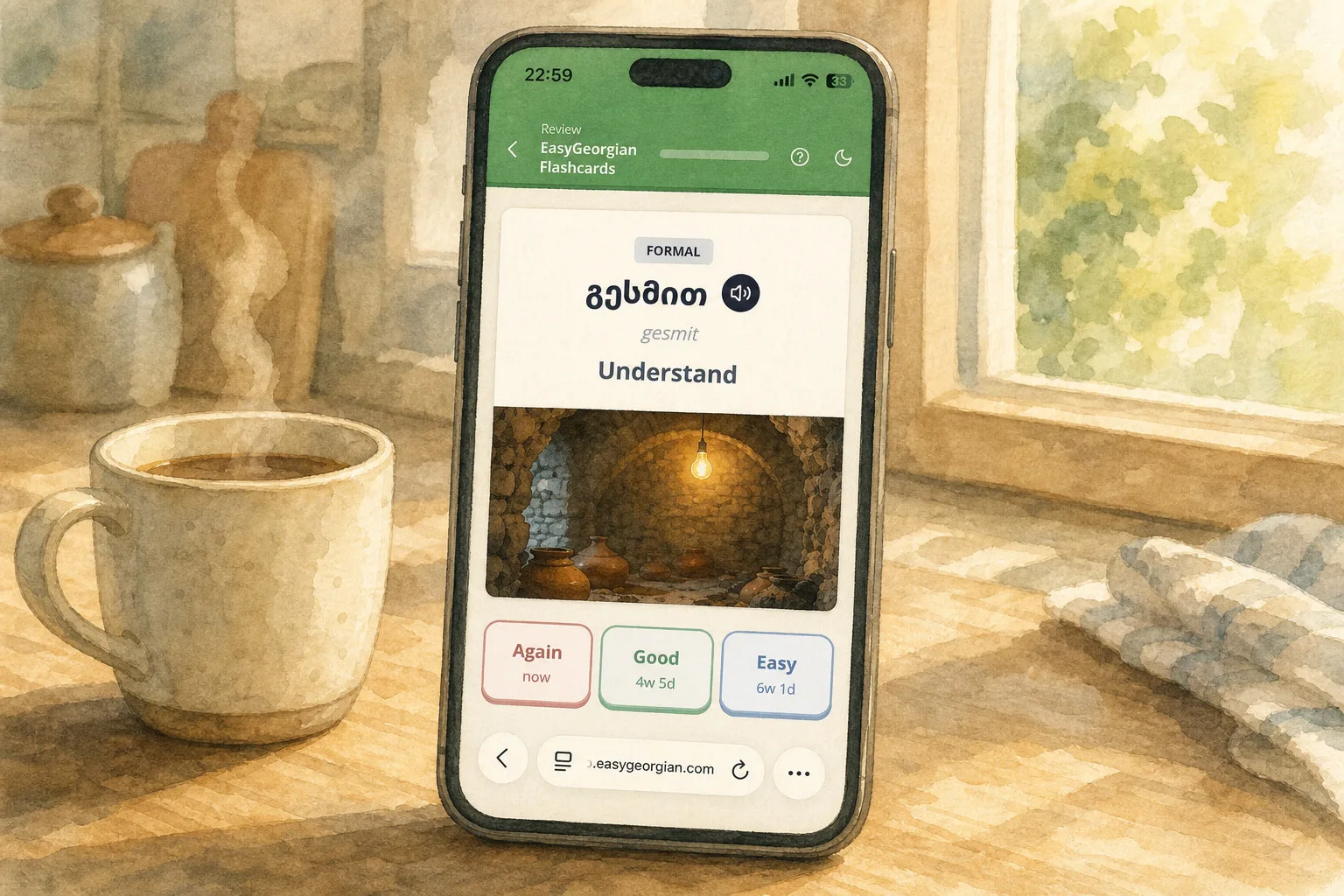
- 4,000+ flashcards. Every card has an image and audio, with three review modes (multiple choice, self-rated, written input with flexible auto-validation).
- A 56-minute alphabet video, free for anyone who signs up.
- The first lesson of both courses, free without signup.
The flashcard system was built specifically against the structural ceiling of user-made Anki decks for Georgian. Image plus audio on every card, validated written input that handles word-order variation, default multiple-choice mode for new cards, the works.
If you are starting from scratch and you only use one tool, this is the one. If you want to layer supplements on top, the post continues below.
Lingwing
Lingwing was founded by Vato Veliashvili in Georgia. Its primary product is helping Georgians learn English and a few other languages. In 2023, with Liberty Bank’s support, Lingwing added a structured Georgian-from-English course aimed at the wave of foreigners moving to Georgia.
The format is gamified, in the Duolingo style: lesson screens, vocabulary drills, multiple-choice exercises. Free tier with optional paid packages.
What works well: there’s real Georgian-language sensibility in the build. The course was made by people who speak Georgian natively, so the audio and the choice of phrases feel right. As a daily streak-style supplement, it’s a good option.
What to be aware of: the Georgian-from-English course is a reverse-direction product on a platform whose primary audience is Georgians learning other languages, and the gamified format trains recognition more than production. If you use Lingwing alongside an audio course you’ll likely get the most out of it. As your only tool, expect to plateau at vocabulary recognition before reaching conversational comfort.
Ling
Ling is a multi-language gamified app with a Georgian course among its 60+ languages. UI in the Duolingo style: streaks, lesson screens, multiple-choice questions, daily-goal nudges. There are some speak-and-record exercises, which add a thin layer of speaking practice. Those drills are lighter than the structured retrieval an audio course delivers, but they’re more than nothing.
What works well: a polished UI, daily-streak engagement loop, free tier, and a feature set familiar to anyone who has used Duolingo for another language. If your learning style is ten minutes a day on the couch, Ling fits that pattern, and the team has clearly invested in the format across many languages.
What to be aware of: Ling’s Georgian course is one of a long shelf, so the curriculum doesn’t go as far as a tool focused only on Georgian could. As your only tool, you’ll likely hit a vocabulary-recognition ceiling within a few months. As a daily supplement alongside a deeper foundation, it earns its place.
Glossika
Glossika uses a mass-sentence-repetition method. About 3,000 native-recorded sentences per language course, paced through an AI-adaptive spaced repetition system. No grammar lessons by design. The bet is that hearing and repeating thousands of full sentences with vocabulary in context trains both the ear and the production reflex more naturally than rule-by-rule grammar instruction.
For Georgian, Glossika has a real course. The audio is native-recorded. The sentences cover topics from daily situations to slightly more abstract content.
Where it shines: pattern recognition through volume, accent and pronunciation work through repetition, and a method that is genuinely audio-first. For someone who has finished an audio course and wants to layer in additional sentence-pattern exposure, Glossika is one of the strongest supplements.
Where it doesn’t: it’s not a beginner’s first tool. Without some grammar intuition or vocabulary baseline, the sentences come at you faster than you can absorb them. Glossika is most useful from late beginner onward.
TalkPal and Talkio
TalkPal and Talkio are AI-conversation-first language-learning apps. TalkPal was founded in 2023 by a Georgian team in Tbilisi (David Gegechkori and Dimitri Dekanozishvili). Talkio is Danish, made by Aidia ApS. Both support Georgian, both use AI tutors for roleplays and voice conversations. The pitch is that talking to an AI tutor is closer to real practice than clicking through multiple-choice questions, which is a reasonable bet for some stages of learning.
For Georgian specifically, the limit on this category right now is that AI models are still catching up to the language. They are excellent at major languages with vast training data and noticeably less polished on Georgian. You will get conversation practice, but the AI sometimes generates phrasings that don’t sound natural to a native speaker, and corrections can drift from canonical usage. This will probably improve over time as the models get better.
What works well: low-stakes speaking practice once you have a foundation. If your survival Georgian is in place from an audio course, an AI conversation partner is a useful way to put more reps in without the social pressure of a real human waiting for you to find the word. What to be aware of: relying on AI conversation alone from zero is a longer road than starting with a structured course, and small AI-generated errors can slip in that you have to unlearn later.
LingQ
LingQ is a content-immersion platform. The mechanic is that you bring real content in your target language, the platform tracks every word you encounter, click-to-translate teaches you the unknowns, and over time the system surfaces the words you’ve seen often. I used LingQ for Russian and it was excellent there, because Russian has effectively unlimited content for an intermediate learner to read and watch.
For Georgian, the format works best when there’s lots of source material at a learner’s level, and that ecosystem for Georgian is still maturing. The corpus is smaller than Russian or Spanish, and most of what exists is either too easy (children’s content) or too hard (literary texts, news) for an intermediate learner. That middle ground will grow over time, and LingQ themselves are clearly investing in adding library content.
What works well: an intermediate Georgian learner who already speaks some of the language and wants to push reading volume. The vocabulary tracking is genuinely useful at that stage, and any content you bring in yourself (Georgian podcasts you find, articles, transcripts) gets the most out of the platform. What to be aware of: as a true beginner there isn’t enough at-level material yet for the platform to feel useful in the first few months.
Anki user-made Georgian decks
Anki is the open-source spaced-repetition system, and the algorithm is genuinely excellent. The catch for Georgian is the deck ecosystem rather than the tool itself.
The user-made Georgian decks on AnkiWeb cap around 1,000 cards, audio coverage is patchy or absent depending on the deck, and none of the decks I found have images. Compared to Anki’s Spanish or Russian decks, where well-maintained 5,000+ card decks with audio and images are standard, the Georgian library hasn’t caught up yet.
I tried Anki for Georgian early in my own Georgian-learning arc. Downloaded the open-source decks, recorded my own audio for the cards I cared about, made it almost work, and quit after a month. The deck-quality gap was the part I couldn’t fix from my end. Worth using if you already trust an Anki workflow. As your first SRS tool for Georgian, the setup cost is high relative to what you get back.
The phrasebook and word-list tier
A handful of apps focus on delivering Georgian phrases or vocabulary lists with audio attached. They are reference tools you can drop into for a specific phrase or a quick pronunciation check, rather than full structured courses.
The names you’ll see in this tier: 50 Languages (100 phrasebook lessons, 30 free), uTalk (around 2,000 words across 60 topics), 17 Minute Languages, LinGo Play, Cudoo, Bluebird, iVoca, Fast - Speak Georgian, and Aso (alphabet only). Quality varies between them. They earn their place as backup phrasebooks for when you need to look up a word fast, less so as a primary learning path.
Beyond these, you’ll also see a long tail of older wordlist websites in the search results. Some are out of date. The phrasebook apps above are usually a better starting point than those.
Language-exchange apps (a different category)
HelloTalk and Tandem are language-exchange platforms, not learning apps. You match with a native Georgian speaker who wants to practice English (or another language you speak), and you trade conversation. iTalki and Preply are tutor-marketplace platforms in roughly the same category, with the difference that you pay a teacher hourly instead of trading practice.
These are useful, but only after you have a foundation. A language exchange in week one is mostly the Georgian person being patient with you while you Google-Translate every sentence. By month three, when you can hold up your end of a basic conversation, the same exchange becomes genuinely valuable.
The honest sequence: foundation first (an audio course), then exchange or tutor for live practice. Not the other way around.
What doesn’t support Georgian
To save you the search:
- Duolingo: no Georgian, no public roadmap.
- Babbel: no Georgian.
- Rosetta Stone: no Georgian.
- Memrise: dropped Georgian some years back. If a 2022 article recommends Memrise for Georgian, it’s out of date.
The major-industry absence is the wedge for everything else in this post. The big platforms looked at Georgian and decided four million native speakers wasn’t worth the build. EasyGeorgian exists to be the proper modern app this language should already have had.
How to actually choose
Start with EasyGeorgian. Try the free first lesson, watch the alphabet video, and decide whether the audio-first format works for you. If it does, the course handles the next eight weeks of your Georgian. The full sequence is laid out in our best way to learn Georgian post, including where teachers and reading practice fit in.
Layer Lingwing or Ling on top for a daily-streak gamified supplement to do on the bus, don’t rely on it for depth. Add Glossika or TalkPal once you’re past survival level if you want to push sentence-pattern volume or AI conversation practice. Save LingQ for when you’re already speaking some Georgian and want to add reading volume. Phrasebook apps are reference tools, fine for the airport, not for learning. Language-exchange apps and a teacher come into play around month three, when you have something to say.
Most learners moving to Georgia in 2026 don’t realize the modern stack for this language has finally caught up. Pick the foundation, layer the supplements, and the language opens up faster than the older expat blogs would have you believe.