

The question every prospective Georgian learner asks. The answer most blogs give is a vague “it depends,” which is true but useless. Here’s a more specific version, with honest brackets.
I’ll work in three milestones: conversational, comfortable, fluent.
Conversational: three to six months
Conversational means you can have basic real-world conversations about real-world things. Order food, take a taxi, ask directions, introduce yourself, talk about your weekend, complain about the weather. Not pretty Georgian. Functional Georgian.
Most learners who put in 30 to 45 minutes a day with the right materials hit this in three months. Some hit it in two. Some need six. The variance has very little to do with talent and a lot to do with what they’re studying.
The fastest learners I’ve seen at this stage almost all do the same thing: audio-first method, daily practice, and some form of forced speaking from week one (a Georgian partner, a tutor, willingness to embarrass themselves at the bakery). The slowest are the ones who try to memorise grammar charts before they’ve spoken any Georgian out loud. They can recite the seven cases by month two and can’t order a coffee.
Our audio course promises this directly: 50 lessons, one per day, conversational by the end. That’s 50 days from zero to ordering coffee, asking directions, holding a basic conversation with your in-laws.
Comfortable: a few more months
Comfortable means you can do most of your daily life in Georgian and feel okay about it. You follow conversations in cafes around you. You can hold a thirty-minute conversation with your in-laws and only switch to English when you’re tired. You read shop signs and short articles. You make jokes that mostly land.
Comfortable is the level where Georgian stops being something you study and starts being something you use. How long it takes depends almost entirely on how much you study and how much speaking you actually do. With our podcast course (one episode a day for 100 days) and continued flashcard work, you can get from conversational to comfortable in roughly another three to four months. With an intensive pace, that window can be much shorter. With a relaxed pace, longer. There’s no single timeline.
What gets you across the gap: volume of comprehensible input (the podcast course, real conversations, Georgian YouTube), continued vocabulary work in the flashcards, and accumulated time speaking. Grammar gets actively useful here. You’ll find yourself looking up specific case-verb pairings to fix patterns you’ve heard but produced wrong.
Most learners who hit conversational and stop there end up plateauing and drifting, usually because the structured course ended and they didn’t replace it with anything. Don’t be one of them. The podcast course is built to be the thing that takes over.
Fluent: three to four years
Fluent means you can do anything in Georgian an adult would do in their native language. Argue with a contractor about a botched plumbing job. Read a Georgian novel. Follow a political debate on TV. Make a toast at a wedding that makes the grandmother cry. Have a serious conversation about something difficult.
Fluent takes years. There is no shortcut, in any language. Three years is on the fast end and assumes consistent practice and immersion. Four to five is more typical. Some advanced markers (literary reading, idiomatic native-level speaking) can take ten.
The good news is that the journey from comfortable to fluent is much less about study and much more about life. Live in Georgia, talk to people, watch Georgian things, read Georgian things. The language fills in over time.
What moves the dial
Some specific things speed up or slow down the timeline.
Living in Georgia speeds it up by a lot. You’re getting incidental input every day. Even at the bakery, even on the marshrutka. Expect roughly half the timeline of someone learning from outside.
Already speaking another Caucasian or ergative-pattern language helps a little. Most foreign learners don’t have this advantage. If you happen to speak Basque or some Caucasian language, the cases will come faster.
Speaking Russian doesn’t help much. People expect it to. The vocabulary overlap is small, the grammar is genuinely different. Russian gets you a few cognates and that’s about it.
Acquisition over studying speeds it up by maybe 30 percent. Audio-driven comprehensible input means you’re picking up patterns naturally, the way a child does, instead of memorising rules in isolation. The grammar reveal still happens later, just much faster because the patterns are already in your head waiting to be named. Textbook-first study front-loads work that doesn’t pay off until much later, and a lot of learners quit before it pays off at all.
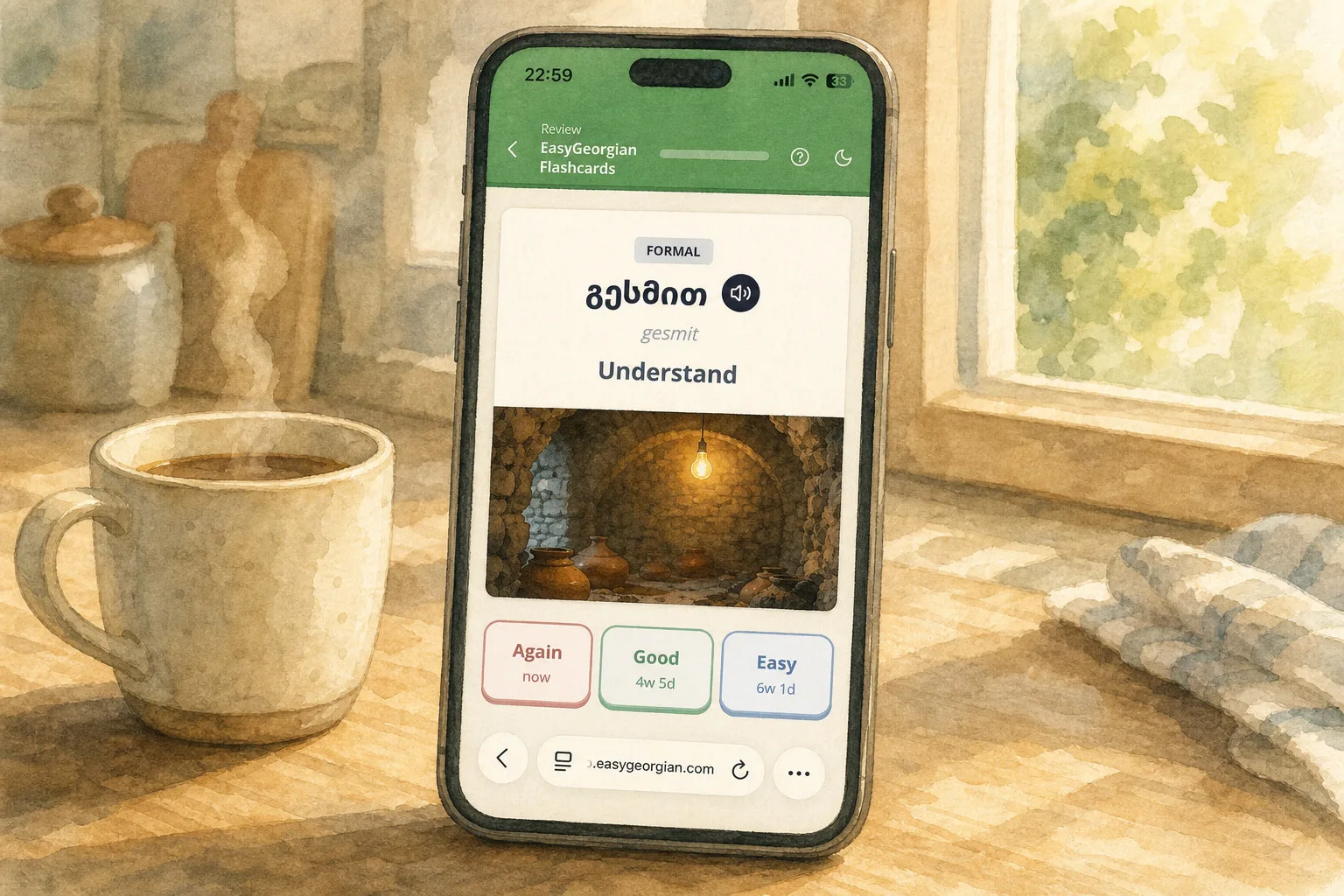
A daily flashcard habit speeds it up. Spaced repetition for vocabulary is one of the biggest leverage points in language learning, and it’s the thing most learners skip because the wrong deck makes them quit. Our in-app flashcards (drawn directly from each course’s vocabulary, with audio and an image on every card) are built so that doesn’t happen. Daily flashcards are roughly worth an extra hour of study per day, in terms of how fast vocabulary actually sticks.
Having a Georgian partner is the single biggest accelerator. Daily exposure plus emotional stakes plus correction without judgment. Many of the fastest learners I know have one.
What slows it down
Studying without speaking. Hours of grammar drills with no production builds head-knowledge that doesn’t survive contact with a real speaker.
Avoiding the alphabet. The alphabet feels intimidating but is genuinely an afternoon’s work. Avoiding it costs months later.
Toggling between methods. Three weeks of Anki, two weeks of textbook, a month of YouTube, then quitting. The most consistent thing beats the most clever thing.
Speaking too rarely. Conversational is the bottleneck, and the conversational reflex only develops with use. Even bad speaking, often, beats good speaking, never.
A reasonable plan
If you have an hour a day and you want to be conversational in three to four months:
- Day 1: 56-minute alphabet video, then start lesson 1 of the audio course the same day.
- Months 1–2: one structured audio-course lesson a day (~30 minutes, full attention, often tiring), plus 15 minutes of flashcards once they unlock. Speak whenever you can.
- Months 3–4: audio course is finished. Priority shifts to input volume plus vocabulary. The comprehensible-input podcast becomes the main material (30+ minutes a day). Flashcards stay daily. Add 15 minutes of speaking practice with a tutor, partner, or out loud to yourself.
- Months 5–12: podcast and other comprehensible input is the bulk. Flashcards stay daily. Conversation hours grow. If you’ve added a teacher, this is the moment to start working on verb rules with them. The podcast course has now seeded the patterns and explicit grammar lands much harder than it would have done in month 2.
That’s the path. It’s slower than the people on YouTube claim and faster than the textbooks make it look. Show up most days. Speak more than you think you should. The numbers above will hit.