

For most people, the first instinct when they decide to learn Georgian is to find a teacher. You open iTalki or Preply, or you ask around in Tbilisi for someone who gives lessons, and you start pricing it out. It feels like the responsible first step.
It usually is not. You can learn Georgian without a teacher, and for the first stretch you are better off without one. This is not an anti-teacher argument. Good Georgian teachers exist and there is a point where one becomes genuinely valuable. That point is just later than most people think.
Do you need a teacher to learn Georgian?
No, not to start. The early stage of Georgian is the stage a teacher serves worst and a structured course serves best.
I can say that from the wrong side of it. Before EasyGeorgian existed, I tried three Georgian teachers. I had already learned other languages through modern audio-first tools, so I knew how I wanted to learn: fast, in real Georgian, no detours. The lessons did not deliver that. One had me handwriting Georgian letters in a notebook to “practice.” Most of the talking happened in English. The grammar got explained before I had any Georgian in my ear for it to attach to. After a stack of lessons I was still at survival phrases and quietly wondering where the money had gone. So I gave up on teachers, and the gap they left is a large part of why I ended up building a course instead.
That experience is common. It is not because the teachers were bad. It is because a one-to-one lesson is the wrong tool for week one of Georgian.
Why a teacher in week one is mostly wasted money
Three things go wrong when you hire a teacher at the very start.
The lesson runs in English. A beginner cannot sustain a conversation in Georgian, so the teacher explains, in English, and you spend most of an expensive hour listening to English about Georgian rather than absorbing Georgian itself.
The grammar arrives unhooked. A teacher will, naturally, teach grammar. But Georgian case endings and verb forms only make sense once your ear has heard the patterns many times. Taught cold, in week one, they are just charts, and charts are what make people decide Georgian is impossible and quit.
And it is expensive for what it is. Tutors run $20 to $35 an hour on iTalki or Preply, and around 35 to 40 GEL an hour for an in-person teacher in Tbilisi. For comparison, a 50-lesson audio course works out to a few dollars per hour of instruction. Paying premium rates for the slowest version of the beginner stage is the core of why early teacher money so often feels wasted.
The no-teacher path
Here is what replaces a teacher for the part of the journey where you do not need one.
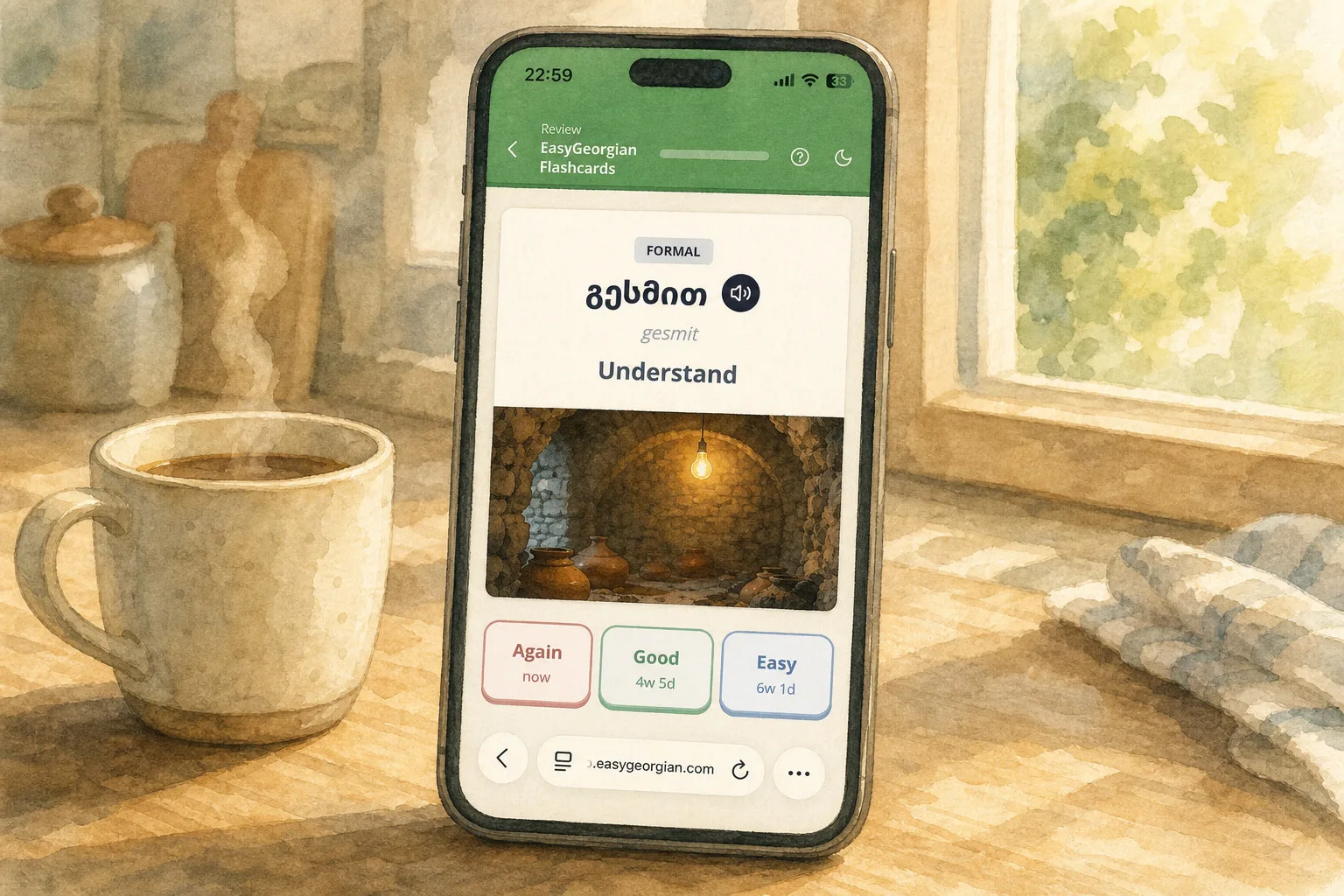
Start with the alphabet. Mkhedruli is 33 phonetic letters and it takes an afternoon, not a course of lessons. Then make a structured audio course your daily spine. Speak Georgian in 50 Days is 50 lessons, one a day, each around half an hour, and it carries you from nothing to a beginner who can actually speak. Review the flashcards tied to each lesson to lock in vocabulary and reading. Once you have a base, add comprehensible-input listening and read whatever Georgian you can find.
That sequence is the whole of the no-teacher path, and it is the same path most Georgian learners now follow, because the language is not on the big apps and a course is the realistic backbone. If you want it laid out in full, our guide on how to learn Georgian has the complete version, and our piece on self-study Georgian goes deeper on doing it solo.
The reason this works without a teacher is the audio-first method underneath it. The course is not a textbook you have to interpret. It prompts you, gives you a beat to produce the Georgian out loud, and then a native speaker says it so you can check. The structure that a teacher would otherwise provide is built into the lessons.
When a teacher becomes worth it
This is the other half of the honest answer. A teacher does become worth it, and the change is sharp.
Once you have a base, once you have finished a beginner course and can hold a simple conversation, a teacher stops being a slow grammar-explainer and becomes something far more useful. The lesson can run mostly in Georgian. They catch the nuanced mistakes your ear cannot catch on its own. They push the grammar forward at exactly the moment it finally has somewhere to land, when the rule names a pattern you have already absorbed and the reaction is “so that is why it works that way.”
I worked with more teachers myself after that point, and it was a completely different relationship. They were not dragging me through survival phrases. They were sharpening Georgian I already had. That is a teacher earning their hourly rate.
When you do reach that stage, choose carefully, because not every teacher fits it either. The one you want speaks Georgian with you, not at you, and keeps the lesson in the language as much as your level allows. Some teachers are still in the handwrite-the-letters-in-a-notebook mode, and that is the wrong fit at any stage. The good ones are out there and there are many of them. Try a few short trial lessons rather than committing to a package up front, and keep the teacher who keeps you in Georgian and pushes you a little past comfortable.
So the rule of thumb is simple. The first months, no teacher. Around the point you can hold a basic conversation, a teacher becomes one of the best things you can add. Teachers are not the enemy here. They are a great supplement, just not a great starting point.
But will I pick up bad habits?
This is the real worry under the question, more than structure or feedback. Without a teacher correcting you, will you fossilize mistakes that are hard to undo later?
Mostly, no, and it is worth seeing why. The mistakes that fossilize are the ones you repeat unchallenged. The audio course challenges every attempt: you produce a phrase, and a native speaker immediately says the correct version. You are not drilling your own errors in a vacuum, you are matching a model again and again. Pronunciation works the same way. You lock in the sounds by imitating the speaker, not by guessing from a written form, which is the opposite of the setup where bad pronunciation hardens.
What can genuinely drift without a teacher is nuance: a slightly-off word choice, a case that is understandable but not quite native, a phrasing a Georgian would not quite use. That drift is real. It is also slow, minor, and fully fixable later, which is one more reason a teacher at month three is well-timed. They arrive in time to catch the nuance before it sets, and long after the point where they would have been an expensive way to do the beginner stage.
Getting the things a teacher would otherwise give you
If you skip a teacher for the first months, it is worth being clear-eyed about what a teacher provides, so you can cover it another way.
A teacher gives you structure. A good course gives you the same thing, a fixed sequence and a clear next step, without the appointment.
A teacher gives you feedback. The audio course gives you a correction on every attempt, because a native speaker says each phrase right after you try it. The flashcards check your recall. Pronunciation locks in the way it always has, by imitating the speaker until you match.
A teacher gives you speaking practice with a real person. This is the one genuine gap, and it is easiest to close if you live in Georgia, where the bakery and the taxi and the neighbors are all practice. If you are not in Georgia, a language-exchange partner covers it once you have a base.
A teacher gives you nuanced correction, the small things only a native ear catches. This is real, and it is also genuinely a later-stage need. It is the reason to add a teacher at month three, not the reason to hire one in week one.
You can learn Georgian without a teacher. Start with the course, keep it daily, and bring in a teacher when you have something for them to sharpen. Georgian has a reputation for being a hard language, but the early difficulty was never the absence of a tutor. It was using the wrong tool too early. The first audio lesson is free, and it is the right place to begin.