
When I first started learning Georgian, I did what most learners do. I went to the shared Georgian decks on AnkiWeb, downloaded a few, and opened them up. Most cards were text on the front, English on the back. Some had audio. None had images. The biggest deck capped out around a thousand words. I recorded my own audio for the cards I cared about, made it almost work, and quit again a month later. The user-made Georgian flashcard decks have a structural ceiling nobody addresses head-on, and most articles about Georgian flashcards skip past it entirely. This is the post about why most Georgian flashcards fail and what to use instead.
The four reasons most Georgian flashcard decks fail
After a year of trying every flashcard option I could find for Georgian, four structural reasons keep coming up:
- Audio is patchy or missing. Some user-made Anki Georgian decks have audio. Many do not. None have it on every card the way a serious deck for Spanish or Russian would.
- No images, on any of them. A bare word in a foreign script does not bind to anything visual. Every card looks like every other card. Memory hates that.
- Limited to about a thousand words. The biggest user-made Georgian decks cap at roughly 1,000 cards, often less. That is enough to start, not enough to finish.
- Limited to one review mode. Anki’s algorithm is excellent, but the review interaction is one shape: see the front, recall the answer in your head, flip the card, rate yourself. That mode (we call it self-rated) works. Written input and multiple choice are useful too, and Anki cannot do them in a way that supports modern Georgian learners.
The rest of this post unpacks each of these and what flashcards built for Georgian look like when the structural problems are addressed.
What text-only cards leave out
The single most important component of a useful Georgian flashcard is the audio. Georgian sounds do not map cleanly to English. The ejective consonants (p’, t’, k’, ts’, ch’, q’) cannot be inferred from their written transliteration. The clusters of consonants Georgian is famous for (gvprtskvni, mkhrebshi) only feel pronounceable once you have heard them many times. A card that shows gvinis without playing it is teaching you a written word, not the word itself.
Images do work that text cannot. A picture of a glass of red wine on a card for ghvino anchors the word to a thing in the world. The brain has somewhere to put it. A bare text card asks the brain to bind a string of letters to a string of other letters. That is technically possible, but the retention curve is much worse than text-plus-image.
When you combine the two, audio plus image, something different happens. The card is no longer testing a translation. It is testing a piece of the world you have associated with a sound. That is closer to how a child learns the word for milk: they hear the sound, see the thing, the bond forms. An adult learner can do this too, given the right cards.
The user-made Anki Georgian decks are inconsistent on this. Some have audio that a maintainer added years ago, with patchy coverage and variable quality. Many have none. None have images. The result is that a learner who picks up a Georgian Anki deck is starting an experience that is materially thinner than the equivalent Spanish or French deck, and most of them do not realize that until they have already given up.
Why decks need to be paired with a method
A flashcard deck on its own is a vocabulary list. It tells you a thousand words exist, in some order. What it does not tell you is which words to learn first, which sentence frames to use them in, or which words you are about to need in lesson 5 of whatever method you are using.
The result is the orphan deck problem. A learner downloads a 1,000-word Georgian deck, starts at the top, and within a week is reviewing words like vlap’arak’ob (I speak) without ever having seen them inside a real sentence. The word floats. It does not stick because it has nothing to stick to.
Decks that are paired with a course do something different. The flashcards in the EasyGeorgian app match the words and phrases as they appear in the audio course lessons. When vlap’arak’ob shows up on a flashcard, the learner has heard it in three full sentences during the audio lesson, used it in a retrieval prompt, and listened to it inside a dialogue between the male and female native speakers. The flashcard is not introducing the word, it is reinforcing one the learner has already met.
That changes everything about retention. The card is not asking the brain to bind a new symbol to a new sound to a new meaning all at once. It is asking the brain to lock in something that already has a context. That is what flashcards are good for. Anything else is asking too much of the format.
Three review modes, not one
Anki’s spaced-repetition algorithm is excellent. What Anki does not give you is a choice of how to review. The interaction is one shape: see the front, recall the answer in your head, flip the card, rate yourself (Again / Hard / Good / Easy). We call that mode self-rated, and it is genuinely fine for most learners most of the time. It is what Anki built its reputation on.
Two other modes matter for adult learners, and Anki cannot do either of them well.
-
Written input. You type the answer. This forces real production, catches the cards a learner thinks they know but cannot actually spell, and is by far the best mode for anyone who wants to improve their writing in Georgian. You can technically build written input into Anki, but Anki does not auto-validate the answer. You sit there comparing letter by letter what you typed against what the card says is correct, manually deciding whether to mark yourself right. That is friction, and most learners abandon written input within a week of trying it.
-
Multiple choice. You see the prompt, four options appear, you pick. Easier than self-rated, easier than written input, more gamified. It is the right mode for absolute beginners and for cold-start days when willpower is thin. Anki cannot do multiple choice at all. Memrise used to do it well, and Memrise no longer supports Georgian.
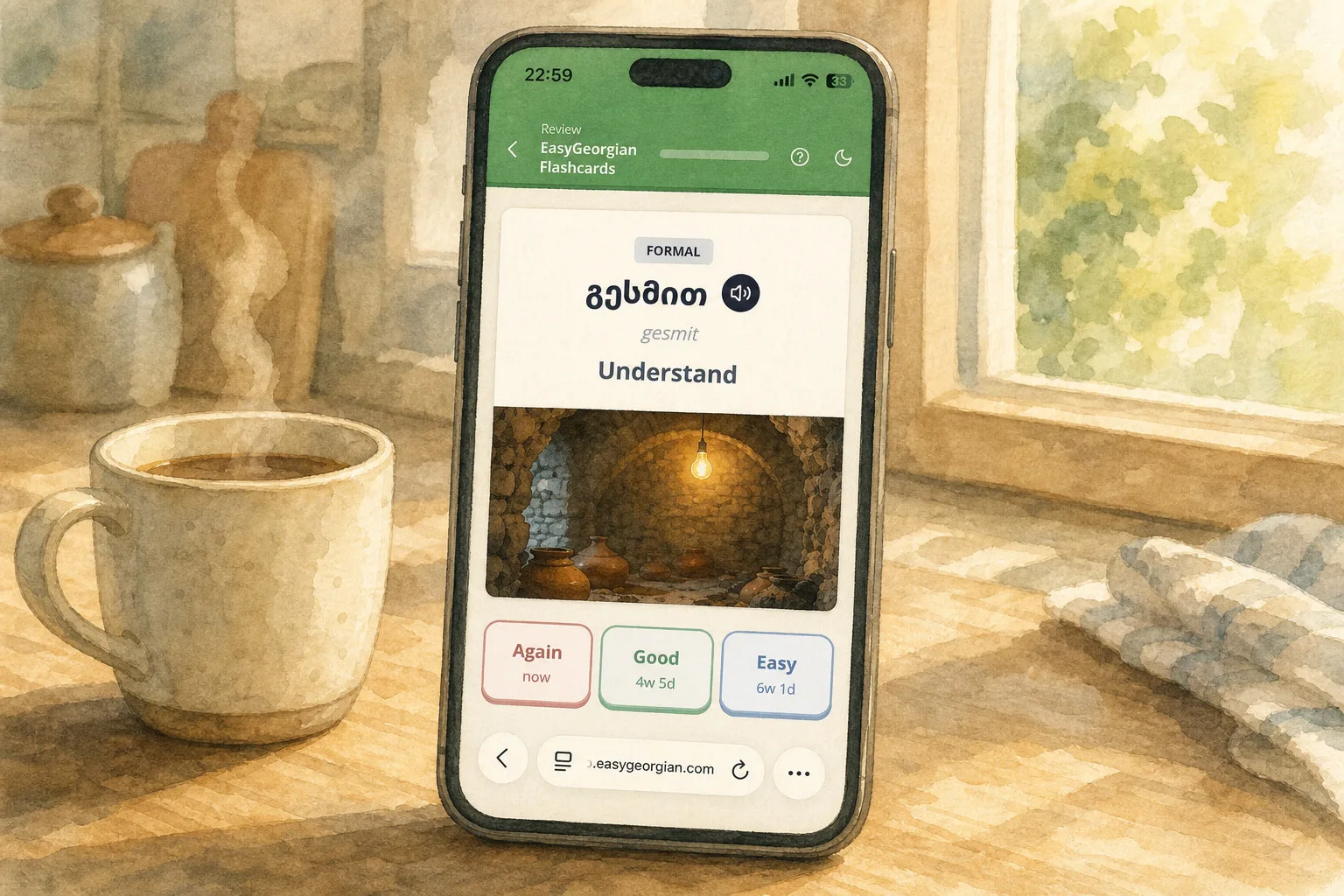
The EasyGeorgian app supports all three modes. Multiple choice is the default for the Learn new sessions where a card appears for the first time. Self-rated and written input are available for review. The learner picks which mode fits the day.
The written input mode includes flexible automatic validation, the part Memrise had right and Anki cannot do. The validator handles word-order variation and optional pronouns. If the card’s expected answer is me var amerikeli (I am American) and you type amerikeli var (I’m American, with the pronoun dropped), the system accepts both. You do not lose your interval level on a technicality. That sounds like a small thing. After a few hundred cards, it is not.
Cycling between modes across review sessions forces a card to be tested from more than one angle. By the time a card is in the long-interval part of the schedule, the learner has retrieved it from English prompt, from Georgian prompt, in their head, on the keyboard, against four options. That is what locks the word into actually-usable memory. Single-mode review does not do this.
What we built instead
The flashcards inside the EasyGeorgian app are designed against every one of the four failure modes:
- Audio on every card. Tamar’s voice (the same female voice on the audio course) is on each card in the audio-course deck. The audio plays automatically as the card flips. Every card. No exceptions.
- An image on every card. A relevant image accompanies each card. The image is generated to match the meaning of the word, and we treat the image as a memory anchor, not as decoration.
- Paired to the courses. The 2,900 cards in the audio-course deck mirror the words and phrases in the 50 audio lessons. The 1,100 cards in the podcast-course deck mirror the second-phase listening course. No duplicates between the decks. Roughly 4,000 cards in total today, growing as we add new content, bundled free with the relevant course purchase.
- Three review modes with flexible written validation. Multiple choice (default for Learn new sessions), self-rated, and written input with auto-validation that handles word-order variation and optional pronouns. The learner picks the mode that matches the day, and the spaced-repetition scheduling treats each card the same way regardless of how it was reviewed.
The decks also include a free alphabet deck, available to anyone who signs up. That part is for absolute beginners who want to learn the script before starting the audio course. The 56-minute alphabet video is the companion to the alphabet deck.
The result is that flashcards in EasyGeorgian feel less like Quizlet and more like an audio-first method you can do on the bus. The brain is doing the same thing it was doing in the lesson: hearing the Georgian, retrieving the meaning. The deck reinforces the lesson rather than competing with it.
When flashcards do not work
Flashcards are not a complete method. They are a reinforcement layer. Anyone who tells you they are a sufficient way to learn Georgian is selling you a particular kind of grind, and the grind has predictable failure modes.
Flashcards alone do not teach you to put words together. A learner who has only done flashcards will know individual words and stall on the first sentence they have to produce. The audio course teaches sentence frames and word order through repeated listening and retrieval. Without that layer, the flashcards are a vocabulary database the learner cannot actually deploy.
Flashcards alone do not teach you to listen at speed. Native Georgian, even slow native Georgian, is faster than card-by-card review. Listening to long-form content, whether the comprehensible input of the podcast course or the dialogues inside the audio lessons, is what builds the listening reflex.
Flashcards alone do not get you past the first plateau. Adult learners typically hit a wall around 500 to 800 words where adding another 100 words does not feel like progress. The fix is more sentences, not more cards.
The right way to use flashcards is as a daily fifteen-to-twenty-minute reinforcement layer alongside an active method. The audio course is the active method. The flashcards stick what the lessons teach. Together they work. Either alone is much weaker than the combination.
For learners who already have a course and want to make their flashcard practice actually pull weight, the best way to learn Georgian post lays out the daily structure that gets the most out of both layers.
If you have been bouncing off the user-made Anki Georgian decks and wondering whether flashcards are even worth doing, the honest answer is yes, just not on a thousand-card text-only deck. Audio, image, paired to a method, three review modes with flexible validation. That is the version that works.