

Most adult Georgian learners start with a textbook. They open it on day one, see a chart of seven cases, panic, and either spend six months memorising tables or quit entirely.
The wedge isn’t audio versus reading, though. The wedge underneath is something deeper: acquiring a language versus studying one. Audio happens to be the best way to make acquisition happen for most adults learning Georgian. That’s the real claim of this post.
Acquiring versus studying
Children don’t study language. Their parents don’t sit them down with a chart of cases and verb conjugations. They hear language in context, over and over, and their brains extract the patterns. By the time they’re old enough to talk about grammar, they already speak.
Adults can do this too. The same pattern-extraction machinery is still there. It’s slower than for kids and a little noisier, but it works. The only catch is that it needs the right kind of input: language you can mostly understand, in volume, in context. Linguists call this comprehensible input. It’s not a religion or a hack. It’s just what acquisition needs.
The textbook approach is the opposite. It frontloads the rules. You memorise the seven cases and the eleven screeves before you’ve used Georgian to say anything. The grammar feels enormous because it isn’t anchored to any sentences you’ve heard. Most learners quit somewhere in the first month.
The acquisition path is dramatically less painful. The grammar still comes in eventually, but later, as a reveal: “ah, that’s why this verb takes the dative there.” By then you’ve heard the pattern fifty times and the chart just names what you already know.
Why audio is the right vehicle for it
Audio is the medium that delivers acquisition-style input most effectively to adult Georgian learners. A few reasons.
It bypasses the alphabet bottleneck. If reading is your primary input mode, the Georgian script becomes a wall before you’ve heard a single sentence. Audio doesn’t need the alphabet at all in week one. You can be acquiring vocabulary while you’re still learning to read.
It teaches pronunciation by default. When you only have audio, you can’t anchor sounds to a written form you’ve imagined. You’re matching what you hear. This matters enormously for Georgian, which has ejective consonants (the p’, t’, k’, ts’, ch’, pronounced with a closed glottis) that English speakers have to physically train their mouths to produce.
I learned Russian and Spanish from audio first. Natives kept mistaking me for one before I was conversational, which created some funny situations. People would chat away thinking I’d understand, and I’d give them my one good Russian phrase back, then stand there silently. The accent was there from day one, exactly because there was no written form to anchor wrong sounds to. The rest had to be built up afterward. That’s the trade-off, and it’s a good one.
It trains mouth and ear at the same time. You’re producing Georgian out loud from lesson 1. Repeating after a speaker locks in muscle memory and listening comprehension simultaneously, in a way reading never can.
The supporting layer of audio scales passively. Comprehensible-input podcasts can run in the background while you cook, walk, fall asleep. Hours of input you wouldn’t get if every minute of learning required sitting at a desk. (The structured audio course itself is different. It’s intense and demands your full attention. More on that below.)
What an audio-course lesson actually does
It’s worth saying what one of these lessons looks like, because “audio-first” is often dumbed down in language-learning advice to “listen and repeat.” That misses what actually happens.
Worth saying upfront: the audio course is not background listening. It demands your full attention. People often finish a 30-minute lesson genuinely tired, like they’ve just done a workout. That’s the active recall doing its work. Best done in a quiet room. Headphones-on while walking is fine if you have a focused environment. The intensity is the price of admission, and it’s also why the course is so effective.
A typical lesson opens with a Georgian dialogue between two native speakers, played at normal pace. You hear it cold. Most of it you don’t understand. The narrator (in English at first) tells you that by the end of the next thirty minutes you will be able to participate in this exact conversation. Then the work begins.
New words come in broken down phonetically, often backwards. The Georgian word uk’atsravad (“excuse me”) is introduced as vad, then ravad, then k’atsravad, then u-, then uk’atsravad, with you repeating each fragment after the speaker. The unfamiliar shape of a Georgian word stops being a wall once you’ve built it up one syllable at a time.
Then the narrator starts prompting you. “How do you say ‘excuse me’?” There’s a beat. You have to retrieve the word from your memory and say it out loud. Then the native speaker says it once or twice. You repeat after each one. Each retrieval makes the word stick a little more.
This is the underrated mechanism: active recall. It’s what separates a structured audio course from background listening. The lesson asks you to retrieve, not just to follow along, and that retrieval is what builds the conversational reflex. Passive listening alone gives you understanding without recall, and people who do only that often plateau into a strange place where they understand a lot but freeze when someone speaks to them. Active recall closes that gap.
As vocabulary stacks up, the prompts move from single words to whole sentences. “How would she answer: ‘No, I don’t understand’?” Same retrieval-then-confirmation pattern, now at sentence length. Repetition is spaced: heavy at first, then at widening intervals across the lesson and across future lessons.
Near the end of the lesson, the dialogue from the start replays. You follow it in real time now. Then a final round runs where the native speakers ask the questions and you provide the answers, with the narrator nudging you only when needed.
Across the 50 lessons of the course, the narrator gradually shifts from English to Georgian. Early lessons are mostly English prompts. Later lessons have the narrator speaking Georgian most of the time. By the last few lessons, the entire experience is in Georgian, and you’re keeping up.
That’s the shape. It’s comprehensible input plus active recall plus spaced repetition plus pronunciation matching, all wrapped around a real Georgian conversation you’ll actually have.
And the podcast course is the other half
The audio course is one of two audio products in the EasyGeorgian stack, and they do different jobs.
The audio course (above) is the structured, recall-driven one. It builds the speaking reflex.
The podcast course (Advance to Georgian Mastery) is the opposite by design: pure comprehensible input, no recall pressure. 100 episodes of slow, ultra-clear Georgian. You listen passively, the transcript is there if you want it, and vocabulary plus patterns stick through volume of input at the sweet spot of difficulty. It’s how children acquire vocabulary at scale, just slowed and clarified for adult learners.
The two products are sequenced, not parallel. The audio course comes first. Once you’ve finished it (and can hold simple conversations), the podcast course takes over as your main study material. Both contribute to acquisition. They just do mechanically different things. The audio course makes you speak. The podcast expands the vocabulary and the listening reach you can speak with.
What if you want visual support
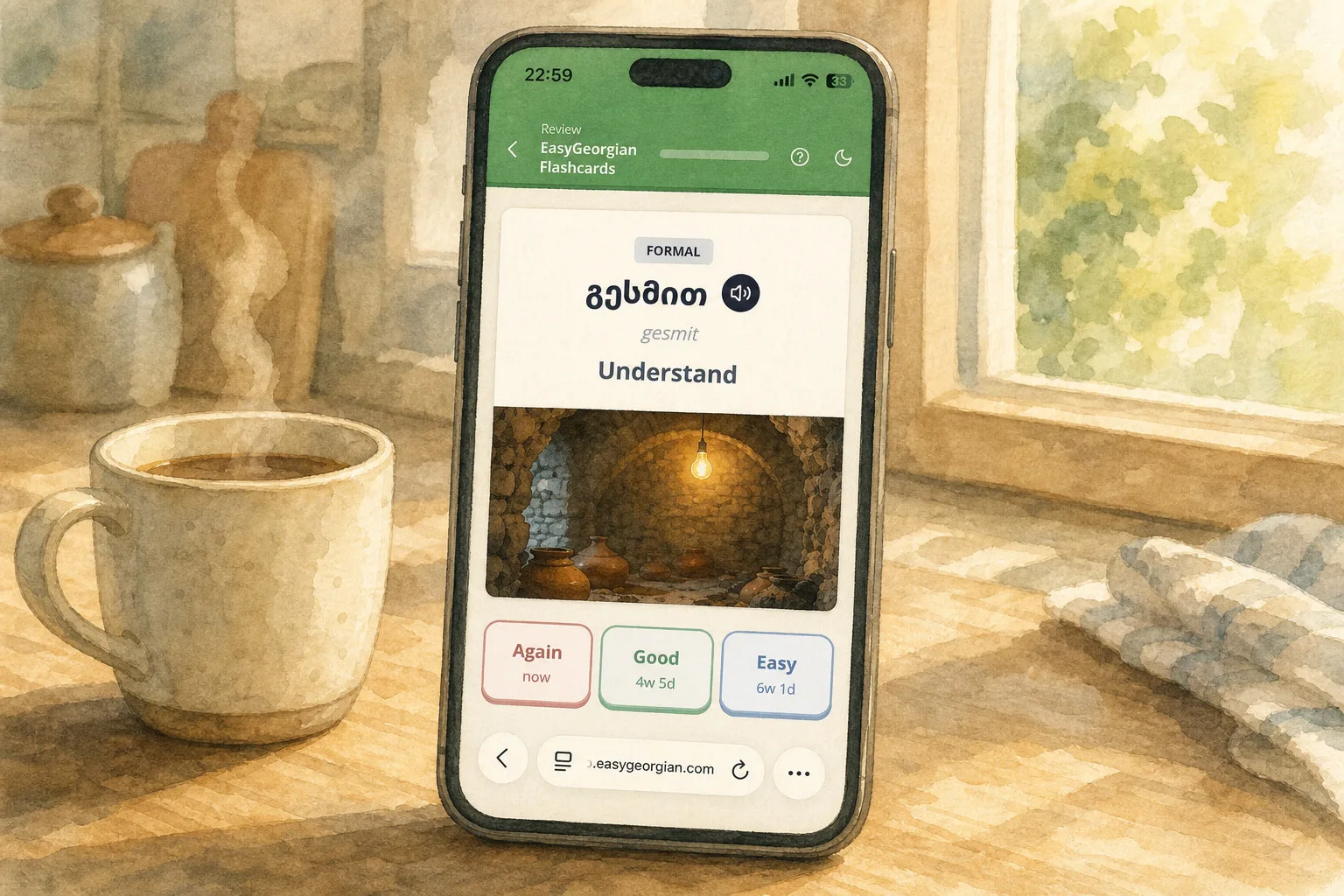
Plenty of learners want to see the words while they hear them. Fair. Visual support is built into the EasyGeorgian app: every audio lesson has the sample vocabulary listed under the player, and the flashcards have multiple review modes including written input for anyone who specifically wants to learn to write.
For most adults, audio-first by default is more efficient. For the visual learners, the visual layer is one tap away on every screen. The two don’t fight each other.
The grammar reveal
After a few weeks of input, you start to notice patterns on your own. Words that always end the same way in a certain context. Verbs that take a particular shape when something happened in the past. Little prefixes that change meaning. You don’t have names for any of it yet, but your ear has caught it.
Then, and only then, the grammar reveal happens. You crack open a grammar reference, or a teacher explains a rule, and the chart that would have intimidated you on day one now reads like a list of things you already know. The “aaah, that’s why” moment is one of the best in language learning, and acquisition-first learners get to have it. Textbook-first learners often quit before they could.
What we built
Our audio course (Speak Georgian in 50 Days) is the structured side of acquisition for Georgian. Fifty lessons of comprehensible input plus prompted speech plus active recall, paired with the alphabet video and flashcards as supporting tools. The podcast course is the volume side, 100 episodes of comprehensible input designed to be listened to passively. The two together get most adult learners to conversational in three to four months.
The shortest path through Georgian is the one that uses your ears. Start there. The grammar is waiting for you at month three, and it’ll feel less like work then.