

You have decided to learn Georgian, and you are doing it alone. Maybe there is no class within reach. Maybe a tutor is not in the budget, or not how you want to spend your evenings. Maybe you have learned other languages on your own and you prefer it that way. The question underneath is the same: can you self-study Georgian and actually get somewhere?
Yes. Self-study is not a compromise for Georgian. It is how most people learn the language now. This post is the plan, plus an honest look at the two things going solo will ask of you.
Can you self-study Georgian?
Yes, and it is worth being clear about why this is not a second-best answer.
For a language like Spanish, you have a thousand options: classes on every corner, the big apps, tutors, immersion programs. Self-study is one road among many. Georgian is different. The major apps skipped it, organized classes thin out fast outside Tbilisi, and that leaves a structured course plus daily practice as the realistic spine for almost everyone. Self-study is not the fallback for Georgian. It is the main road.
The doubt most people bring to this is whether, without a teacher watching, they will do it wrong. It is a fair worry, and the answer is that a good course is the structure. You are not improvising. You are following a sequence built by people who know the language, in the right order, with the practice built in. What a teacher would otherwise provide, a plan and a path, the course provides. What is genuinely on you is showing up. More on that below.
There is also a quieter point. Georgian is better acquired than studied. You do not need someone explaining case charts at you in week one. You need a lot of Georgian going into your ears at a level you can follow, and steady practice producing it. That is something you can do alone, on a schedule that fits your life.
A self-study plan that works
Here is a self-study plan you can start today. It is the same shape whether you are in Tbilisi or have never been to Georgia.
- Day one: the alphabet. Learn to read Mkhedruli. It is 33 phonetic letters and it takes an afternoon, not a week. The free 56-minute alphabet video in the EasyGeorgian app does it in one sitting by showing letters in context rather than as a chart. Do not let this step become a project.
- The same evening: start the audio course. This is the spine of the whole plan. Speak Georgian in 50 Days is 50 lessons of structured audio, one a day, each around half an hour. It carries you from no Georgian to a confident beginner who can speak.
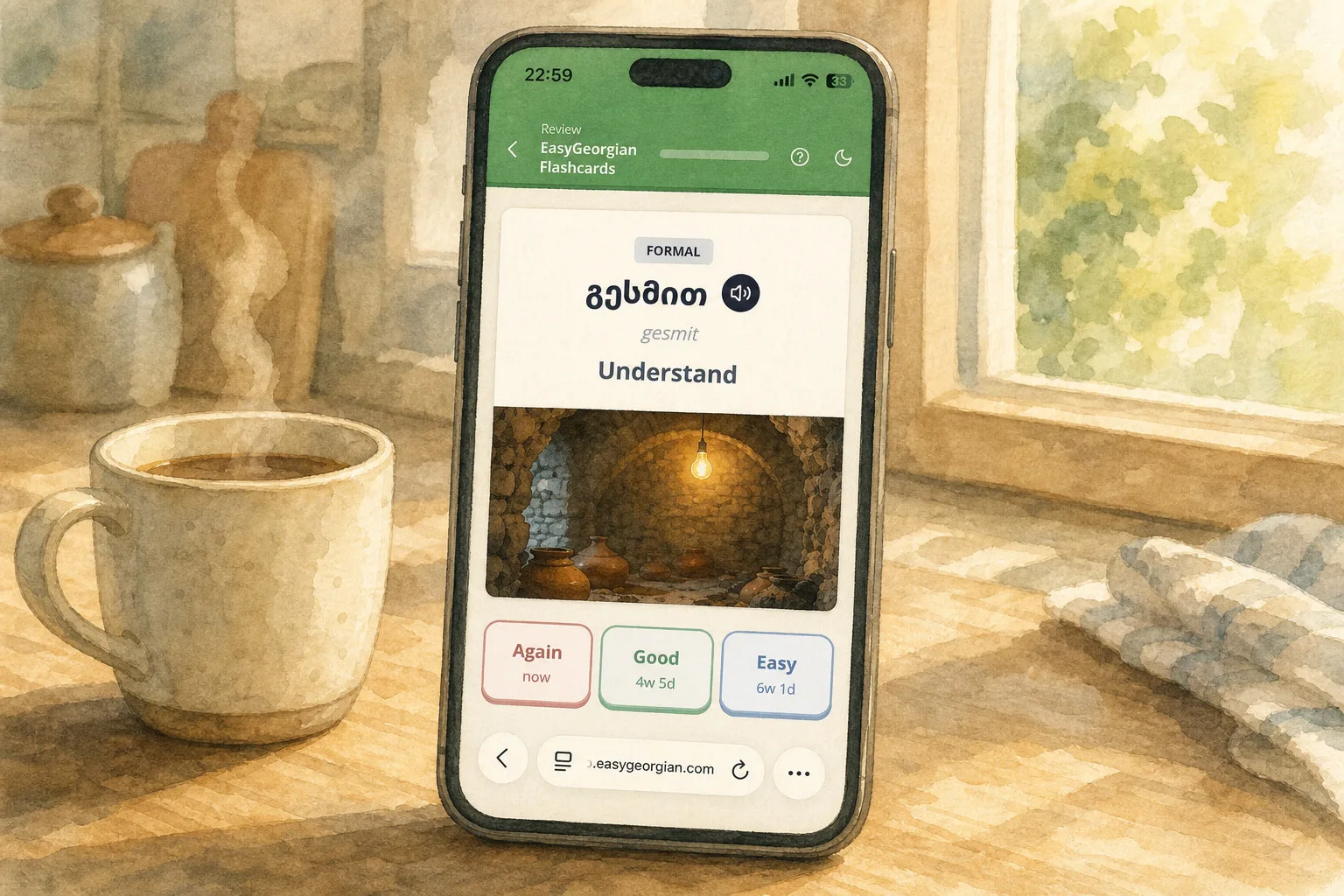
- Alongside it: flashcards. Review the flashcard deck tied to each lesson. This locks in the vocabulary and gives you reading practice without it feeling like study.
- From month two: comprehensible input. Once the audio course has given you a base, the priority becomes listening volume. A comprehensible-input podcast at the right level grows your ear while you go about your day.
- Throughout: read and speak. Read anything you can, signs, menus, children’s books. Speak out loud at every chance, even single words. These are not separate study sessions, they are habits you fold into normal life.
A realistic pace sits underneath that. The alphabet is day one. The audio course is roughly the next two months at one lesson a day, and that stretch does the heavy lifting, taking you from no Georgian to a beginner who can hold a simple conversation. From there it opens up: the podcast course and reading become the main material, and there is no fixed finish line, because at that point you are simply living with more and more Georgian. The first two months are the part that needs real discipline. After that the habit mostly carries itself.
That is the plan. It is not complicated, and that is the point. A self-studier does not need a clever system. They need a clear sequence and the discipline to follow it.
The tools a self-studier needs
A common self-study mistake is collecting tools. Five apps, three textbooks, a folder of PDFs, a YouTube playlist. The pile feels like progress and produces almost none, because attention is split across all of it and consistency lands on none of it.
You need a small set. An audio course as the daily spine. A flashcard system for vocabulary and reading, ideally one with audio and images on the cards rather than the bare-text Georgian flashcards you find in user-made decks. Comprehensible-input listening for after the base is built. And Georgian to read, which is free and everywhere.
EasyGeorgian was built to be exactly this small set in one place, because it is the set I wished existed when I was learning. The audio course, the podcast course, and roughly 4,000 flashcards with audio and an image on every card, paired so the words on the cards match the lessons. One spine, not a pile.
The two hard parts of going solo
Self-study works. But it asks two things of you that a class would otherwise enforce, and both are worth naming honestly.
The first is consistency. A class is a fixed appointment with another person, and that social pressure carries a lot of learners through the dull middle weeks. Self-study has none of it. Nobody notices if you skip a day, and skipped days quietly become skipped weeks. The fix is structural, not motivational. Put the audio course in a fixed daily slot, the same time every day, attached to something you already do, the coffee, the commute, the hour after dinner. Pick a course that tells you exactly what the next lesson is so there is no daily decision to negotiate with yourself. And keep the progress visible, lessons completed, flashcards due, so you can see the line moving. None of that depends on motivation, which is the point, because motivation is exactly the thing that will not be there on a wet Tuesday in week five.
The second is the feedback loop. With no teacher, the worry is “how do I know I am doing it right?” This one matters less than it feels like it should. The audio course gives you feedback on every single attempt: it prompts you, you produce the Georgian out loud, and a native speaker immediately says it correctly. That is a correction, every few seconds, built into the format. The flashcards check your written answers. Pronunciation locks in the same way it always has, by imitating the speaker until you match. The genuine gap a solo learner has is conversational nuance, the small things a native ear catches, and that gap is real but it is a month-three problem, not a week-one one.
How to tell it is working
The thing a class gives you that self-study does not is another person saying “yes, you are getting somewhere.” Solo, you read your own progress. The good news is that Georgian gives you clear, honest signals if you know what to watch for.
Early on, the signal is reading. Within a week or two you can sound out a shop sign or a metro station without working at the letters. That is the alphabet done, and it is the first proof the plan is moving.
A dozen lessons into the audio course, the signal is the lesson dialogues. Each lesson opens with a conversation you mostly cannot follow and ends with you able to. When that arc starts to feel reliable rather than lucky, your comprehension is climbing.
Later, the signal moves outside the course entirely. You catch a word in a conversation you were not part of. You say something to a shopkeeper and it comes out before you have translated it. You read a sign you have walked past for months. None of these is a test score, and together they are a more honest progress report than a grade, because they are the language working in your actual life.
If those signals stall for a long stretch, the cause is almost always the same: the daily practice slipped. The fix is never a new app. It is the fixed slot, put back in place.
Where a teacher fits in
Self-study and a teacher are not opposites. They are stages.
For the first weeks, a teacher is mostly wasted money. Half the lesson runs in English, the grammar explained is not yet hooked to anything you can hear or say, and you pay $20 to $35 an hour for it. A structured course does that early stage better and far cheaper.
Later, once you have a base, a teacher becomes genuinely valuable. The lesson can run mostly in Georgian, they catch the nuance self-study cannot, and they push your grammar forward at the point where it finally lands. If you want the full picture of that timing, we wrote a separate piece on how to learn Georgian without a teacher and when adding one starts to pay off.
So: can you self-study Georgian? Yes, and well. Follow a real sequence, keep it daily, lean on a course that carries the structure for you, and add a teacher later if you want one. The best way to learn Georgian on your own is not a secret. It is a plan, followed. The first audio lesson is free, and that is where the plan starts. For the complete version of the sequence, our guide on how to learn Georgian lays it all out.