

There is no single best way to learn Georgian. There is a best stack. The shape of that stack has changed in the last two or three years, because the resources for Georgian have finally caught up to what’s been standard for major languages for over a decade.
This is what’s actually available in 2026, what each thing is good for, and how I’d put it together if I were starting from scratch today.
What you can use
Audio courses. Structured lessons that train your mouth to produce Georgian out loud. The Georgian-language industry didn’t have a real one until very recently. Our Speak Georgian in 50 Days is the first dedicated audio course of this kind for Georgian, modelled on the same prompted-speech pattern that has worked for major languages for years. There are some scattered audio resources elsewhere, mostly on YouTube, but nothing structured to take you from zero to conversational over a defined arc.
Comprehensible-input podcasts. Slow, ultra-clear Georgian, paced for a learner who has already finished the audio course (or is otherwise at A1 to A2 level and able to hold simple conversations). Our Advance to Georgian Mastery podcast course (100 episodes) is built around this model. Each episode follows the same structure (intro, dialogue, vocab discussion in Georgian, dialogue replayed slightly faster, outro), with a karaoke-style transcript and translation modes you can dial up or down.
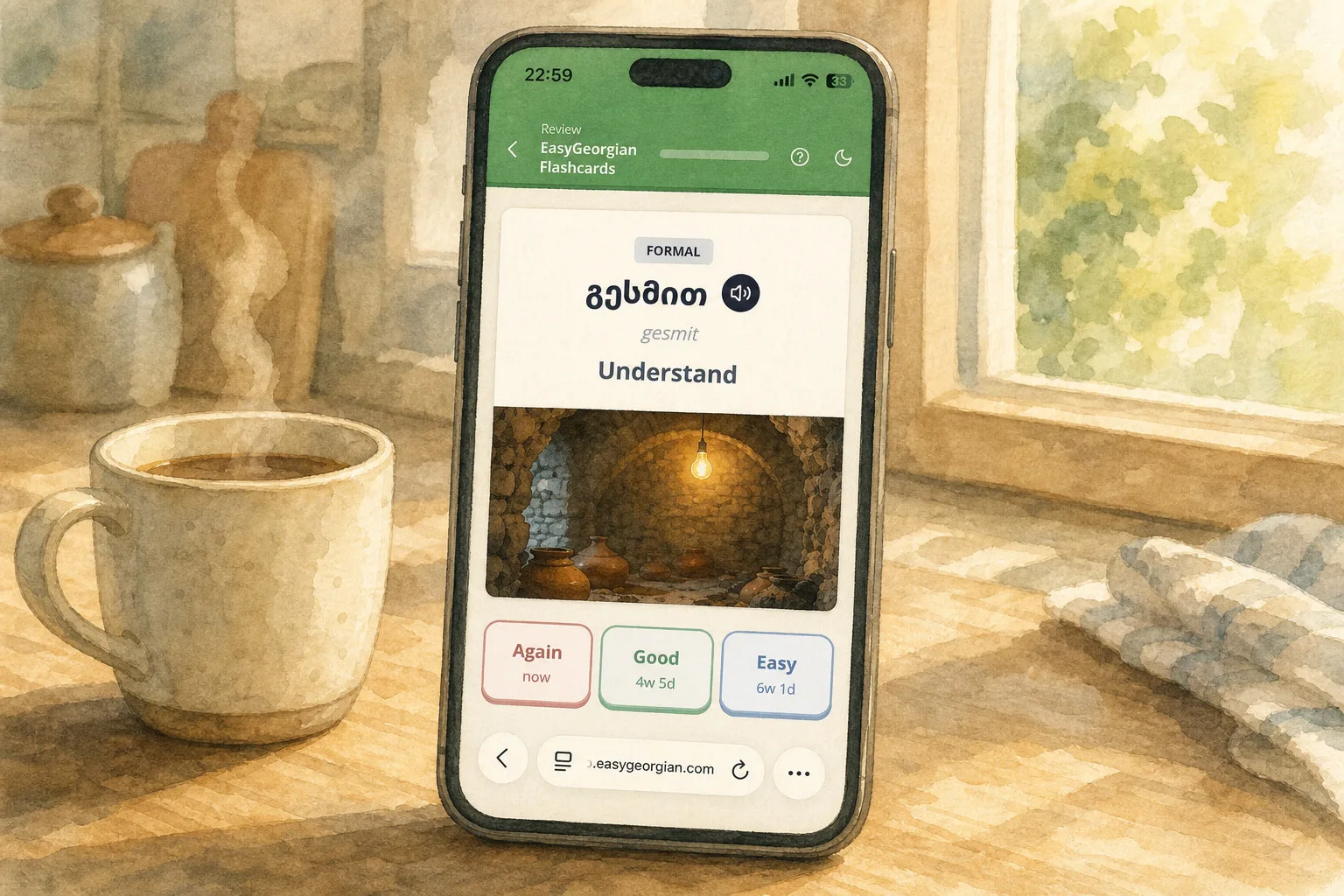
Flashcards. Spaced repetition for vocabulary. Anki works in theory and there are user-built Georgian decks, mostly bare-text cards without audio or images. Memrise doesn’t support Georgian. Our in-app flashcard system has 4,000+ cards, every card with an image and audio. Cards cover both our courses’ vocabulary, plus a free alphabet deck.
Free alphabet video. A 56-minute video inside the EasyGeorgian app, free with signup. It teaches the script through context, not chart memorisation. As far as I know it’s the only thing of its kind that exists for the Georgian alphabet.
Textbooks. A handful exist. The good ones are dense and grammar-heavy. They are useful as a reference once you already speak some Georgian. They are a difficult on-ramp for a beginner, because they front-load grammar before you have anything to apply it to.
Teachers. Plentiful, in person in Tbilisi or online (iTalki, Preply). Quality varies wildly. Hourly cost is real: $10–35/hour online, around $7.50/hour for the cheapest local in-person tutors. Many are excellent. Many spend most of the lesson talking to you in English. Try a few before committing.
The big language apps. Duolingo, Memrise, Babbel, Pimsleur, Rosetta Stone. None of them support Georgian. This is part of why the resources for Georgian have lagged: there has been no big-platform reason to invest. EasyGeorgian exists to be that platform, focused only on this language.
How to put them together
The best stack, in 2026, in the order I would actually use it:
Day 1. Watch the 56-minute alphabet video. Start the first lesson of the audio course the same evening. Walk into one bakery and try a sentence.
Weeks 1–7. One audio-course lesson a day. The course is intense (active recall, full attention required, often tiring), so do it in a quiet room or with headphones in a focused setting. Flashcards once they unlock from the lessons. Speak whenever you can.
Months 2 onward. The audio course is finished. Now the priority is volume of input plus vocabulary. The podcast course (Advance to Georgian Mastery) takes over as your main study material. You’ll understand a meaningful share of each episode by this point and infer most of the rest. Flashcards stay daily. Reading whatever Georgian you can find. Optional: add a teacher, but if you’re going to dive into verb rules with one, consider waiting until after the podcast course is done. The podcast covers a lot of natural verb-tense usage in easy forms, and the explicit rules click much better once the patterns are already in your ear.
Forever. Speak. Speak constantly. Speak badly. Speak to anyone who will hold still. The conversational reflex is the bottleneck for almost every adult learner, and it does not develop unless you use the language.
Why this beats the alternatives
The textbook-first approach (which is what most teachers default to) gives you grammar without input. You memorise the cases before you have heard them in a sentence. The grammar feels enormous because it is not anchored to anything you can hear or say. Most people quit somewhere in the first month.
The teacher-only approach gives you input but without volume. One hour a week, mostly in English, is not enough to train an ear. After six months you have spent maybe twenty hours of contact time and your Georgian has barely moved.
The single-app approach (Anki alone, or YouTube alone) gives you raw material but no structure. You have to design your own week, your own progression. Most people don’t, and they drift.
The stack works because each piece does what it is good at: audio for the mouth, comprehensible input for the ear, flashcards for the words, alphabet video for the script, optional teacher for the polish. EasyGeorgian was built specifically to be that stack for Georgian.
What’s actually different in 2026
Three years ago this stack didn’t exist for Georgian. The audio course wasn’t there. The comprehensible-input podcast wasn’t there. The flashcard system with audio and images on every card wasn’t there. The alphabet video wasn’t there.
Now they are. The honest answer to “what’s the best way to learn Georgian” has changed because the available tools have changed. If you’re starting today, you’re starting in a much better moment than anyone before you.
Start with the alphabet video. It’s free. Most of the rest you can try over a free first lesson, or buy as a one-off, no subscription.