


This is the one I’d hand a friend who was visiting Tbilisi for a week, with a quick note next to each phrase about when I actually use it. After five years living here, these are the 20 sentences that have come up the most often in everyday situations: ordering at the bakery, taking a marshrutka, raising a glass at a family table.
Each one has the Georgian script, transliteration, and a play button. Tap the button to hear the phrase from a native speaker. The voice is the same one you’d hear in our audio course, so you’re matching the real thing, not a synthetic approximation.
Greetings
The default greeting. Same word for “hi” and “hello,” any time of day. Use freely with everyone.
The standard goodbye. Slightly formal but works in any context, from a shopkeeper to a friend’s parents.
Literally “morning of peace.” Used until late morning. A nice one to land before noon.
The evening counterpart. Used from the late afternoon onward. Common at restaurants and supras.
Yes, no, thanks, sorry, please
The everyday “yes.” There are formal and informal variants, but this one works everywhere.
Plain “no.” You’ll hear it constantly.
Everyday “thank you.” Use it at every interaction. Georgians notice.
Literally “big thanks.” For when something genuinely impressed you, or as a default at restaurants when you leave.
Apologise and get someone’s attention politely. Versatile.
This is your “please.” It goes at the end of any request. Madloba covers thanks. tu sheidzleba covers please. Pair them with anything.
Eating and drinking
Notice tu sheidzleba doing its job. Or just point at the table and say angarishi.
Say this and the kitchen will come to thank you. Compliments on food are a reliable warmth-generator at any Georgian table.
The phrase that opens any order. Combine with whatever you want, or follow with the dish name and a smile.
A worked example. Tsot’a is “some / a little.” Useful at supras, where you might want to slow your wine intake without saying so directly.
Getting around
The bones of any “where is…” question. Sad aris is “where is,” kucha is “street.” Swap kucha for any place name to ask where it is.
The answer you’ll hear most often when you ask for directions. Or use it yourself to a taxi driver.
For directions and for telling drivers which way to turn.
The other side. The cluster of consonants is real and the audio is the only honest way to learn it.
The most natural way to ask “how much?” in Georgian. Use at markets, taxis, anywhere prices aren’t posted.
At the supra (because you’ll be at one)
The toast word. Said with every glass raised at every supra, in response to whatever the tamada has just toasted. If you walk into Georgia knowing only one phrase, make it this one.
A pronunciation note
The Georgian r is rolled, like Spanish or Italian. Rolled-ish is fine.
The kh (as in nakhvamdis) is the back-of-the-throat sound, closer to the Scottish “ch” in loch than to an English “k.” The gh (as in ghirs) is the same place in the throat, voiced.
The ejective consonants (the ones marked with an apostrophe in the transliteration: k’, p’, t’, ts’, ch’) are the hardest part of Georgian pronunciation. Don’t worry about them as a traveler. Your accent will be clearly foreign anyway, and Georgians are extraordinarily forgiving of foreigners making the effort.
What this gets you
Twenty phrases is enough to navigate a week in Georgia warmly. The locals will respond visibly differently to a foreigner who has bothered to learn even this much. The bar for being praised is low, and the response when you clear it is one of the genuinely lovely things about being here.
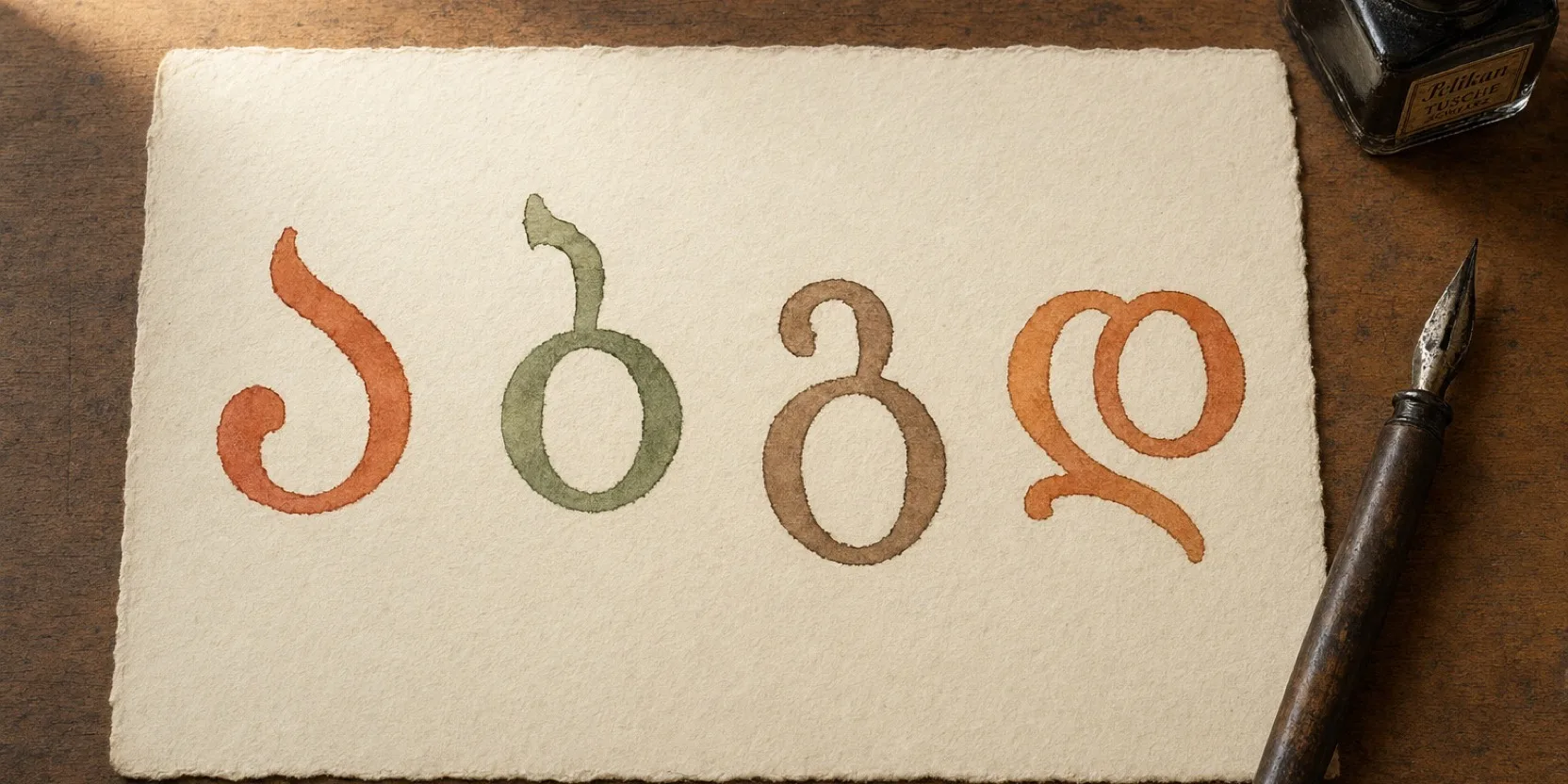
If you’re staying longer than a week, the alphabet is an afternoon’s work and unlocks a whole layer of context. After that, an audio course will get you to actual conversations within a few months. The first lesson of ours is free if you want a sample.