
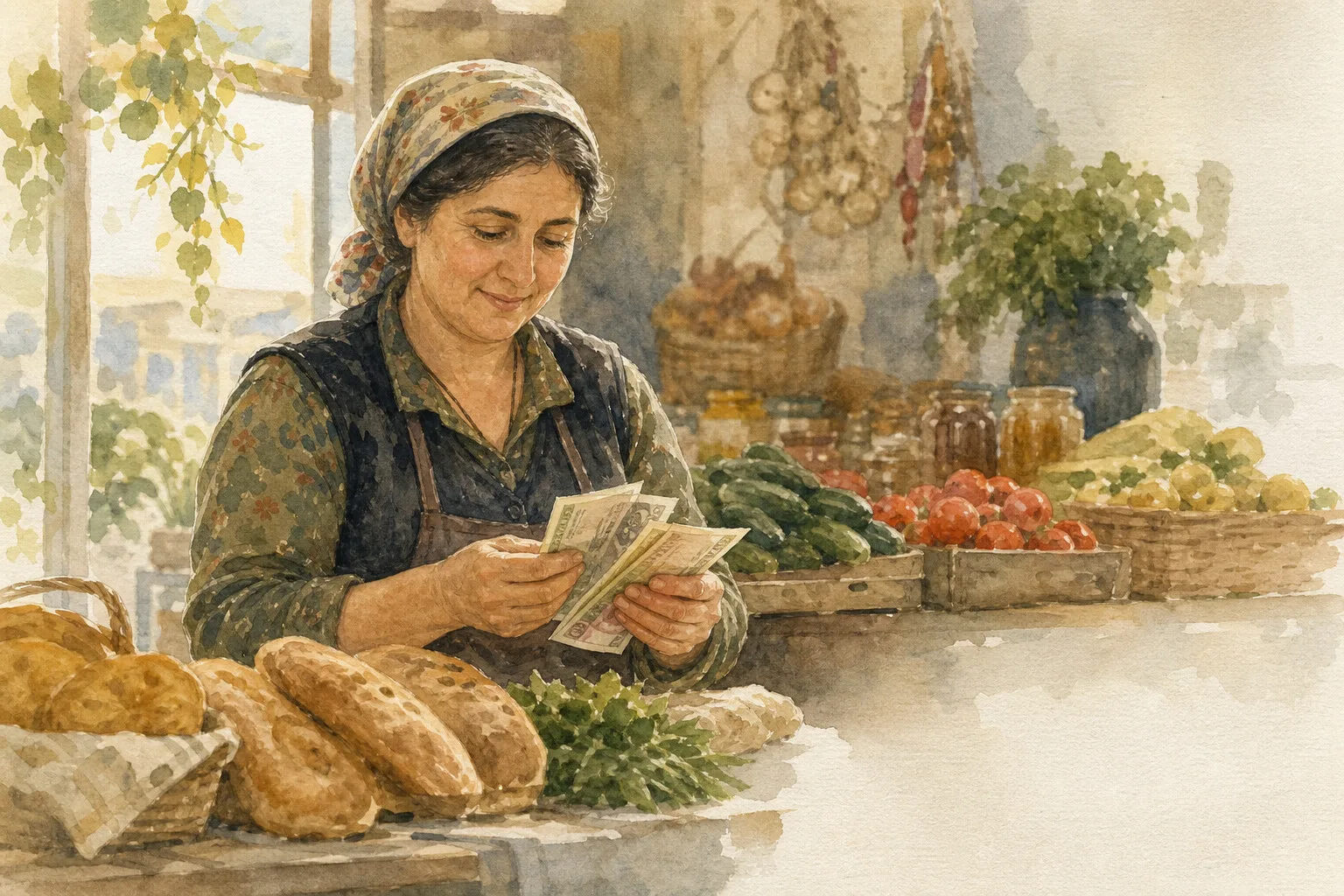

At a Tbilisi supermarket, the cashier might say ormotsdaati lari, ormotsi tetri. That sentence is the price 50 lari and 40 tetri. To an ear new to Georgian, the lari and the tetri land cleanly and the rest of it is mush.
Georgian counts in twenties above nineteen. Ormotsdaati is “two-twenty-and-ten”, fifty. Ormotsi is “two-twenty”, forty. Nothing about that lines up with the Indo-European number patterns most learners’ ears have been trained on. The chart looks impossible. After enough listening, prices start clicking before you have to think about them.
This is the post I wish I’d had at the start. Counting to a hundred in Georgian, with the structure named so the chart actually makes sense, and audio on every number so the shapes lock into the ear.
How to count to ten
The first ten numbers are primitives. Short words, no irregular forms, all introduced across lessons 8 to 11 of the audio course. Listen and repeat each one a couple of times.
A note that saves time: rva (8) and tskhra (9) are the two that look least like the others. The r and ts clusters are unusual mouth-shapes for English speakers. Worth saying them out loud a few times each.
Eleven to nineteen, the -met’i pattern
After ten, Georgian builds the teens around a shared -met’i suffix. The leading consonants are sound-shifted echoes of the digits 1-9, contracted in ways that take a few rounds of audio to land. The shapes aren’t quite a clean recipe you can derive from scratch, but the family resemblance is loud once you hear them in sequence.
Listen for the -met’i at the end of each. That’s the constant. The first part of each word is a sound-shifted echo of the matching digit: erti shows up in tertmet’i (11), otkhi in totkhmet’i (14), tskhra in tskhramet’i (19), and so on.
The teens look intimidating in writing because the consonant clusters are dense. In the ear, after a few rounds of audio, they shrink into single recognisable shapes. You stop spelling them in your head and you start hearing them as words.
The vigesimal twist
This is where Georgian breaks from the European pattern. From twenty onward, the system goes base-20.
Here’s the logic. Twenty is a single primitive word: otsi. From there, the language counts in groups of twenty.
- 40 is two twenties: ormotsi. Or- is two, -ots- is the recurring twenty-marker (with an m inserted for pronunciation in 40 and 80), -i is the noun ending.
- 60 is three twenties: samotsi. Sam- is three. No m insertion in this one.
- 80 is four twenties: otkhmotsi. Otkh- is four. M inserted again.
The 30, 50, 70, 90 series fills in the gaps. Take the previous twenty-multiple, drop the final -i, add -da-ati (literally “and ten”). So:
- 30 = 20 + 10 = otsdaati
- 50 = 40 + 10 = ormotsdaati
- 70 = 60 + 10 = samotsdaati
- 90 = 80 + 10 = otkhmotsdaati
Once you see the pattern, the entire range from 20 to 99 collapses into “what’s the nearest twenty below it, plus the leftover.” There are no new words to memorize. Just the recipe.
Vigesimal counting isn’t unique to Georgian. French has fragments of it (quatre-vingts for 80). Basque does the same thing across its full range. Some Mayan languages, Danish in archaic forms, Yoruba in West Africa. Georgian is one of the cleaner systems still in daily use. Once you’ve internalized the pattern, you’ll start noticing it on price tags and in market chatter, and it stops feeling exotic.
Compound numbers, hundreds, thousands
For any number between two twenties, you stack the same recipe. Take the lower base (20, 40, 60, or 80), drop its final -i, add da (and), and follow with whatever 1-19 gets you to the target.
- 33 = 20 + 13: otsdatsamet’i
- 35 = 20 + 15: otsdatkhutmet’i
- 44 = 40 + 4: ormotsdaotkhi
- 75 = 60 + 15: samotsdatkhutmet’i
- 95 = 80 + 15: otkhmotsdatkhutmet’i
Hear a few of those:
Past 99, the language returns to single primitive words.
A hundred is asi. Same shape as the digits 1-10. From there you stack: as ormotsdaati is “a hundred and fifty,” literally “hundred two-twenty-and-ten.” A thousand is atasi, from ati (ten) plus asi (hundred), so the language calls a thousand “ten hundred.” Hear them in real sentences:
Zero is nuli. It comes from the international borrowed pattern rather than the older Kartvelian counting system, which is why it sits outside the otherwise-elegant erti-through-ati sequence. You’ll see nuli on price tags, on receipts, and on phone numbers more than in spoken counting.
Where you’ll actually use these
Numbers come up faster than learners expect. The bakery counter on a Sunday morning is a numbers conversation: erti p’uri, tu sheidzleba (one bread, please), and the cashier comes back with erti lari, ormotsi tetri (one lari, forty tetri). Intercity marshrutkas have flat fares the driver quotes before you depart. Taxis quote round numbers in lari before you get in. Phone numbers are read out in two- and three-digit groups, the same vigesimal forms you just learned, which is one practical reason to internalize the pattern instead of mentally stopping at ati.
The fastest way to get fluent with Georgian numbers is to use them in transactions. Practicing aloud at the bakery, asking how much something costs at the bazari, repeating the price back to confirm you heard it. Wrong every time at first. Right with practice. The audio course threads numbers through every lesson from 8 onward, in real conversational shapes: paying for bread, ordering coffee, exchanging currency, telling time. By lesson 28 you’ve heard 1 through 99 in dozens of contexts and the vigesimal pattern is no longer surprising.
If you want the audio-first version of all this, that’s Speak Georgian in 50 Days, and the first lesson is free.